
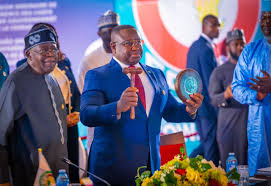
President Julius Maada Bio has assumed the chairmanship of the Economic Community of West African States (ECOWAS), succeeding Nigeria’s President Bola Ahmed Tinubu at the 67th Ordinary Session of the Authority of Heads of State and Government in Abuja. His election comes as the bloc marks its 50th anniversary amid unprecedented turmoil, from military coups and economic strain to the withdrawal of three member states.
This is only the third time a Sierra Leonean leader has held the post since the founding of ECOWAS in 1975. Bio follows in the footsteps of former presidents Valentine Strasser and Ahmad Tejan Kabbah, both of whom chaired the organisation during periods of regional uncertainty. The timing of his appointment is seen by many as both a national honour and a critical test of leadership.
Bio takes over a weakened ECOWAS, now reduced to twelve members after Mali, Burkina Faso, and Niger left in January to form the Alliance of Sahel States (AES). Their exit, driven by frustration over sanctions and political isolation, has fractured regional cooperation. The Sahel faces deepening insecurity as jihadist groups linked to Al-Qaeda and the Islamic State expand operations into coastal states such as Togo and Benin.
In his first address as chair, Bio said ECOWAS must be “people-centred and action-oriented,” promising reforms to restore unity, security, and trust. He set out four main priorities for his one-year term: restoring constitutional order and democracy, strengthening regional security, unlocking economic integration, and rebuilding institutional credibility.
Bio acknowledged that West Africa is facing what he called a “crisis of democracy.” Since 2020, eight coups or attempted coups have taken place in the region, with Guinea still suspended and the AES countries under military rule. Constitutional manipulation and electoral disputes have eroded public confidence in civilian governments, weakening the bloc’s moral authority.
To reverse this trend, Bio is expected to push for stricter enforcement of the ECOWAS Protocol on Democracy and Good Governance, regular peer reviews, and incentives for electoral reform. He is also likely to engage in behind-the-scenes diplomacy to support political transitions in volatile states such as Senegal and Côte d’Ivoire.
Observers say that rebuilding democratic credibility could also open the door for talks with the AES members, whose withdrawal has left a political and security vacuum.
The security situation across the Sahel remains ECOWAS’s most urgent challenge. The regional Standby Force, designed for collective defence, is underfunded and underused. Terror attacks have displaced millions, drained national budgets, and disrupted trade routes.
Bio told the summit that “sanctions alone will not work” and proposed the appointment of a former military head of state to lead an ECOWAS task force. The team would design a new strategy for engaging the breakaway Sahel states and for preventing future coups.
Experts say Bio’s experience as a former soldier could help him navigate security diplomacy between civilian leaders and military juntas. He is also expected to prioritise cooperation with the African Union and the United Nations to strengthen peacekeeping and intelligence sharing.
Economic recovery and integration form another major pillar of Bio’s agenda. Intra-regional trade across ECOWAS remains stagnant at about 12 percent, far below the levels in other regional blocs. The departure of the AES states disrupted key trade routes, including those for Niger’s uranium exports, and deepened regional inequality.
Bio wants to accelerate implementation of the African Continental Free Trade Area (AfCFTA) within ECOWAS, harmonise tariffs, and push for investment in regional transport corridors such as Abidjan–Lagos. He also supports reviving the long-delayed Eco single-currency project to ease cross-border business and promote digital trade.
Analysts estimate that stronger integration could add up to 7 billion dollars to the regional economy by 2030 and make ECOWAS more resilient to external shocks.
Public trust in ECOWAS has faded, with critics accusing the bloc of slow decision-making and opaque finances. Nigeria covers roughly 60 percent of the organisation’s budget, creating dependency that undermines equality among members.
Bio has pledged to restore transparency through public audits, better communication, and citizen engagement. He plans to launch a charter for public participation and to expand outreach through local media and online platforms.
Diplomats say this reform effort will be crucial for restoring ECOWAS’s image as a community of people, not only governments.
Two immediate challenges could define Bio’s tenure.
The first is the Sahel crisis. The AES withdrawal has left millions exposed to insurgent violence and humanitarian crises. Bio has called for dialogue and reconciliation instead of confrontation, signalling a shift from the bloc’s earlier stance of isolation and sanctions. He plans to appoint a Special Envoy to lead a regional task force to engage the Sahel states on security cooperation and constitutional reform.
The second challenge is closer to home. The long-running border dispute with Guinea over Yenga remains unresolved despite a 2004 agreement recognising the village as part of Sierra Leone. Guinean troops continue to occupy the area. The ECOWAS summit urged both sides to “de-escalate, dialogue, and demilitarise,” and agreed to send a fact-finding mission.
Bio is expected to establish a national Yenga Committee, made up of diplomats, lawyers, historians, and local representatives, to work with ECOWAS and the Mano River Union toward a permanent settlement within one year. Resolving Yenga would be a major diplomatic success for Sierra Leone and a signal of ECOWAS’s renewed credibility in conflict resolution.
“Fix Yenga, calm the Sahel, and Bio writes himself into history,” said a lecturer at Fourah Bay College. “Fail, and ECOWAS could shrink further.”
As chair, Bio must steer a region struggling with coups, division, and distrust while proving that dialogue and cooperation can still work. His leadership will shape ECOWAS’s future and Sierra Leone’s standing in West Africa.
The next twelve months will test both.