
Sierra Leone’s recent victory over the 2025 Mpox outbreak, over 5,000 cases and 60 deaths, has been overshadowed by a new health crisis.
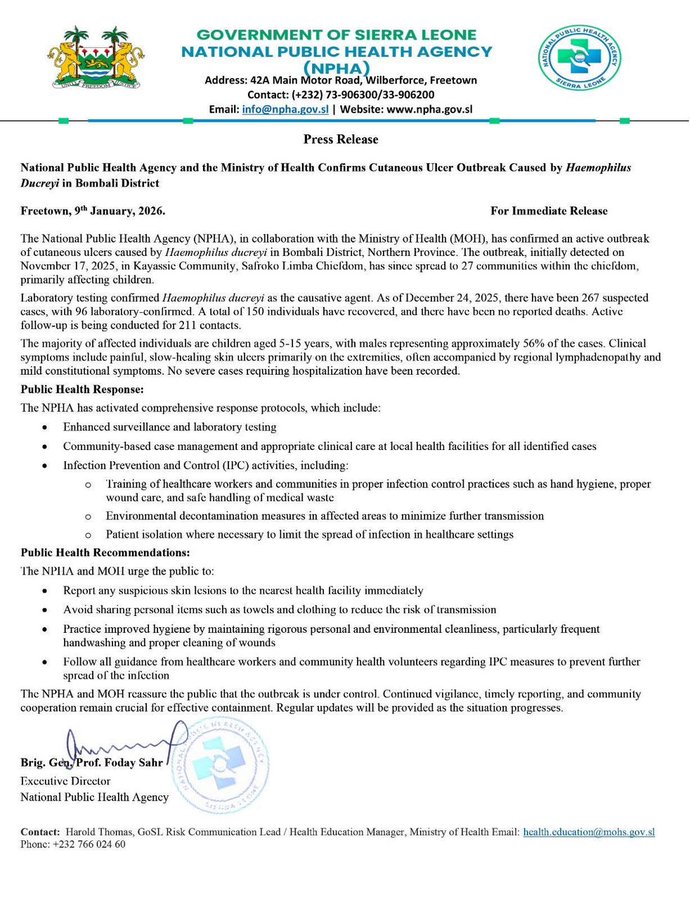
On January 9, 2026, the National Public Health Agency (NPHA) and Ministry of Health confirmed an outbreak of cutaneous ulcers caused by Haemophilus ducreyi in Bombali District. First detected November 17, 2025, in Kayassie Community, it spread to 27 communities, with lab confirmation by December 24 yielding 267 suspected cases, 96 confirmed, 150 recoveries and no deaths. Primarily affecting children aged 5-15 with painful, slow-healing ulcers on extremities, the infection spreads via poor hygiene or shared items.
The NPHA’s response including enhanced surveillance, lab testing, infection prevention training, wound care, and decontamination, has contained it. Public advice includes avoiding shared towels, frequent handwashing, and following health guidelines. Yet, why announce this over a month after confirmation and nearly two months after detection? This delay echoes the 2014-2016 Ebola crisis, where initial silence fueled escalation. Without early alerts, families may have unwittingly spread the infection, allowing misinformation to thrive.
Officials point to caution, investigations, and the holiday period as explanations, yet these reasons carry little weight in a country shaped by the memory of Ebola, where delayed communication once allowed fear, rumours, and loss of life to spread faster than the virus itself.
Public trust depends on transparency, because communities can handle uncertainty when leaders speak honestly, but confidence erodes when information arrives late and without explanation, creating space for rumours and suspicion.
This outbreak did not require secrecy, as an early advisory explaining symptoms, transmission routes, and basic precautions would have empowered parents and communities while avoiding panic, especially given that the disease responds well to simple hygiene measures.
Other countries in the region have shown that speed strengthens trust, as seen when Ghana issued prompt public alerts during Mpox outbreaks, helping communities respond quickly and responsibly.
Sierra Leone has invested heavily in laboratories, surveillance systems, and health infrastructure since Ebola, yet resilience depends as much on communication as on equipment, because public health succeeds only when people receive timely, clear information.
Future outbreaks will occur, and children will remain vulnerable, so authorities must commit to early public engagement through radio, community leaders, and mobile communication, sharing what is known, admitting uncertainty, and updating regularly.
Hidden wounds worsen when ignored, while openness protects lives and trust alike, and Sierra Leone’s children deserve a public health system that speaks early, clearly, and honestly.