
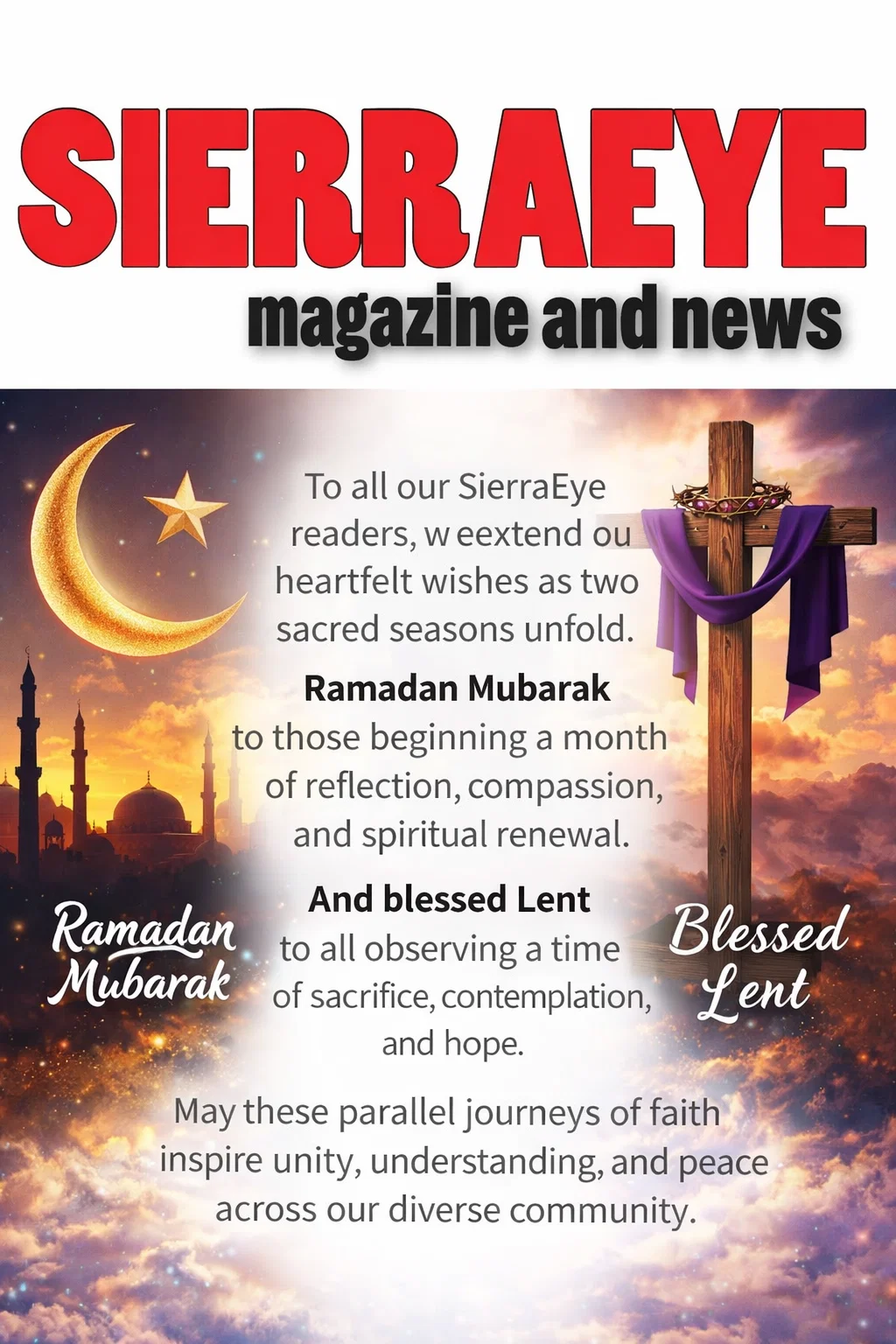
Sierra Leone continues to show daily signs of shared religious life through ordinary conduct that brings Muslim and Christian communities into close and respectful contact across towns, villages, and neighbourhoods. The call to prayer rises from mosques and travels across streets where church bells ring in reply, while families move with ease between religious spaces during festivals and family events.
Muslims and Christians form most of the population, and many families include members of both faiths, which strengthens social trust through personal relationships rather than abstract ideals. Shared meals during Christmas and Eid remain common practice, though dwindling, and these exchanges reflect long habits of respect rooted in lived experience rather than formal agreement. This harmony grew through years of collective effort, mutual reliance during periods of hardship, and a shared commitment to social peace.
The overlapping arrival of Lent and Ramadan places renewed responsibility on religious communities to practise restraint, reflection, and care for neighbours in ways that reinforce social stability rather than weaken social trust. Both seasons call believers to discipline personal conduct and to strengthen moral responsibility toward others, which should support public harmony across faith lines. Recent events, though limited in scale, show pressure on this social fabric and signal the need for steady leadership.
In late 2025, a video circulated widely online in which an imam urged Muslims to reject Christmas greetings and gifts from Christian neighbours, while framing such everyday gestures as forbidden and warning of spiritual punishment. This message conflicted with long-standing social practice across Sierra Leone, where reciprocal greetings and shared meals remain part of ordinary community life.
The Sierra Leone Police acted swiftly by arresting the Imam on charges of incitement. Following his release, the imam issued a public apology that national leaders, including Vice President Juldeh Jalloh, acknowledged, while the Ministry of Social Welfare issued a statement urging restraint and renewed interfaith dialogue. The speed and clarity of these responses helped contain harm and reaffirm public standards for respectful religious expression.
A separate dispute highlights how institutional rules can produce social tension when they fail to account for religious practice. Muslim alumni of St Joseph’s Secondary School and Annie Walsh Memorial School have been engrossed in bitter disputes ahead of their annual Thanksgiving March, regarding approval for modest dress that aligns with Islamic practice, including long dresses below the knee and simple head covering.
Schools’ uniform policies prevent such accommodation. Some alumni argue that this amounts to discrimination that violates Section 24 on freedom of conscience and Section 26 on protection from discrimination in the 1991 Constitution. A disagreement over dress standards now risks becoming a constitutional dispute, which would deepen mistrust between institutions and faith communities if leadership fails to respond with care and legal clarity.
Small disputes become wider conflict when public and religious leaders delay action or rely on silence rather than clear guidance. Sierra Leone preserved stability through deliberate engagement by faith leaders, civil groups, and community elders during periods of tension. The Inter-Religious Council of Sierra Leone needs to return to consistent leadership rather than crisis response by organising joint forums during Lent and Ramadan, supporting youth exchanges between madrasas and seminaries, and facilitating structured dialogue between school administrators and alumni groups. Public affirmation of interfaith families as part of national life should form part of these efforts, since social unity grows through visible recognition of shared belonging.
Religious leaders shape daily conduct through sermons, teaching, and community engagement, which gives them a direct role in protecting social cohesion. Imams and pastors should reinforce messages of respect by teaching principles rooted in scripture, including the Quran’s teaching on freedom of belief and the Gospel’s call to love one’s neighbour, while publicly correcting messages that promote isolation or hostility. Clear public guidance limits the space for extreme views to gain influence, while consistent moral leadership strengthens everyday trust.
Government carries responsibility for setting fair standards across public life and for enforcing laws without favour or delay. Law enforcement should continue to address incitement consistently, while public institutions should receive guidance on lawful accommodation of religious practice. Education authorities should train school leaders on constitutional duties related to freedom of conscience and equal treatment, and civic education should form part of the curriculum in primary and secondary schools to build habits of respect from an early age. Policy and practice together shape public conduct more effectively than statements alone.
Lent and Ramadan provide practical disciplines that support empathy, restraint, and responsibility, which belong in public conduct as much as in private devotion. Choose dialogue over rigid positions. Choose fair accommodation over symbolic disputes. Protect social unity through consistent action in schools, places of worship, public institutions, and everyday interaction.
Sierra Leone stands as proof that communities of different faiths share public life without fear when leadership acts with clarity and restraint. This record demands care through early intervention, clear standards, and steady engagement across faith lines.