
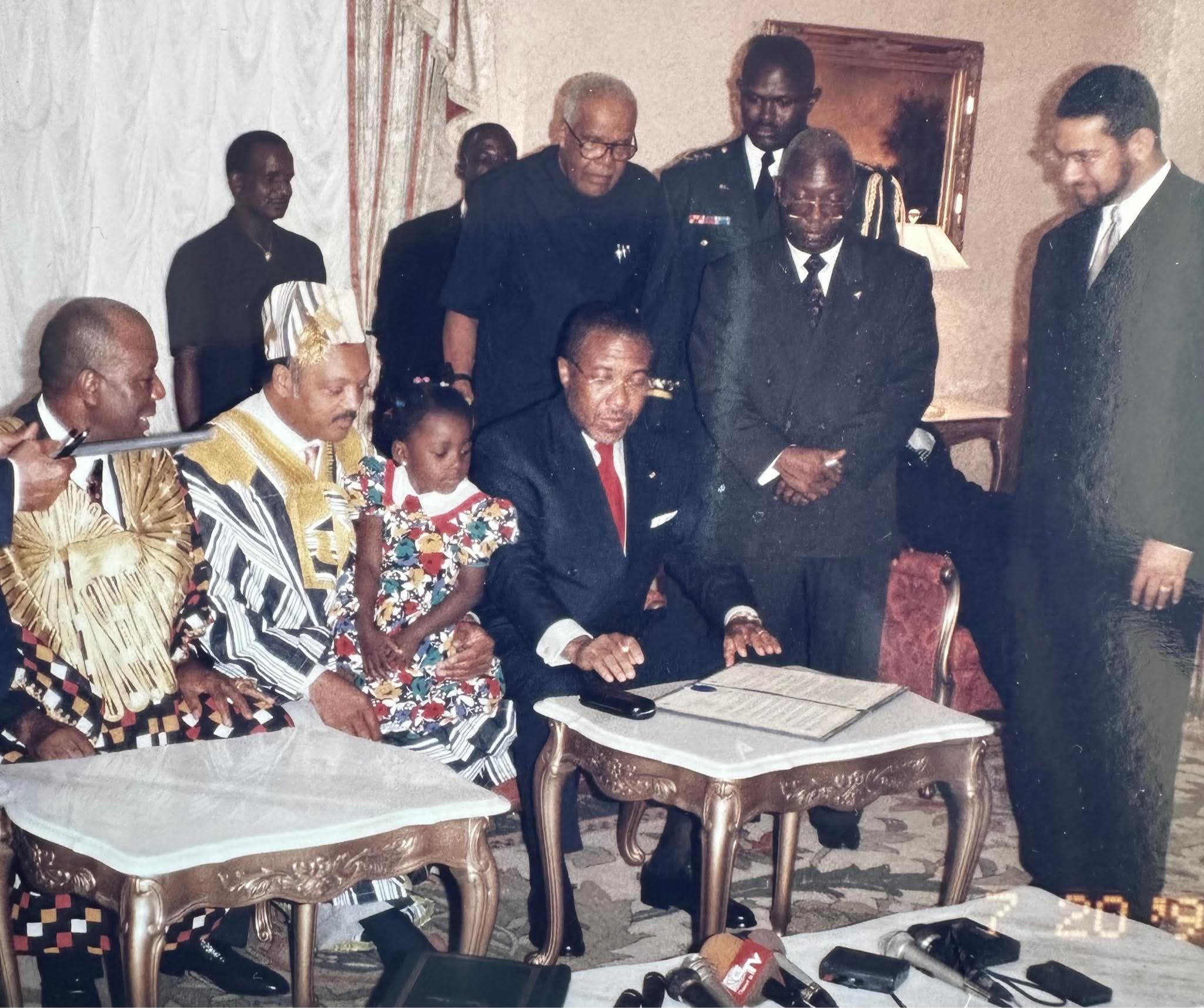
Reverend Jesse Louis Jackson Sr.’s passed awayon February 17, 2026, at the age of 84 in Chicago. Jackson, civil rights leader, Baptist minister, and global advocate for justice, died after a long battle with a rare neurological disorder that had slowly taken his mobility and voice. His legacy in the United States is well known. It includes marching alongside Dr. Martin Luther King Jr., championing economic justice through Operation PUSH (People United to Serve Humanity), and building the Rainbow Coalition to unite marginalized communities. Yet for us in Sierra Leone, it is his diplomatic forays into our region, earnest, ambitious, and sometimes controversial, that demand our focused remembrance.
Jackson’s engagement with Sierra Leone came during one of the darkest chapters of our national story, the civil war of 1991–2002, a conflict defined by blood diamonds, child soldiers, mass displacement, and atrocities that scarred generations. Appointed in 1997 by U.S. President Bill Clinton as Special Envoy for the Promotion of Democracy in Africa, Jackson sought to leverage his experience in conflict mediation and anti apartheid activism to help stabilize a region in flames.
His first major engagement came in November 1998, when he visited Sierra Leone as part of a West African tour. Meeting President Ahmad Tejan Kabbah and Mano River Union leaders, he emphasized regional security and toured sites of devastation, speaking with war victims and amputees. At a moment when our democratically elected government, recently restored after the 1997 coup, needed international solidarity, Jackson’s presence signalled that the world had not turned away.
His most consequential intervention unfolded months later. In May 1999, Jackson helped mediate a cease-fire in Lomé between President Kabbah and RUF leader Foday Sankoh. That fragile pause opened the door to the Lomé Peace Accord of July 7, 1999, which promised disarmament, power sharing, and a path toward reconciliation. The accord ultimately faltered, but at the time it offered a rare glimmer of hope. Jackson’s “aggressive diplomacy,” as some described it, encouraged Kabbah to pursue peace not only through force but through negotiation, a reminder that even in war, dialogue can shift the terrain.
But Sierra Leoneans also remember the missteps. Jackson’s approach, though well intentioned, sometimes betrayed a limited grasp of our political and cultural landscape. When the RUF violated the Lomé Accord in 2000 by capturing UN peacekeepers and reigniting violence, Jackson launched a “Mission of Hope” to revive talks. It was during this period that he made his most controversial remark, suggesting that the RUF’s actions placed them in a category comparable to Nelson Mandela’s African National Congress. “There’s blood on everybody’s hands,” he said, “nobody is clean.”
For many Sierra Leoneans, this was a painful false equivalence. Foreign Minister Sama Banya publicly rebuked the comparison, arguing that it conflated a terrorist insurgency with a legitimate liberation movement. Jackson later clarified that he never intended to equate the two, but the damage was done. His visit to Freetown was delayed, and public sentiment cooled.
Critics saw in Jackson’s envoy role a broader pattern of American overconfidence, where high profile personalities overshadowed local expertise. The collapse of the Lomé Accord, followed by decisive British intervention, underscored the limits of external mediation in deeply rooted conflicts. Jackson’s legacy in Sierra Leone is therefore complex. He amplified our plight on the world stage and pushed for peace, yet his interventions also revealed the pitfalls of diplomacy unmoored from local nuance.
Still, to view Jackson only through the lens of Sierra Leone would be to miss the breadth of his Pan African commitments. He was a fierce opponent of apartheid, lobbying global leaders for sanctions and Mandela’s release. He championed Africa’s economic sovereignty and spoke passionately about the continent’s right to chart its own future. Tributes from across Africa, including Liberia, South Africa, and beyond, reflect a man who believed deeply in the interconnectedness of Black struggles worldwide. As the General Secretary of the South African Federation of Trade Unions, Zwelinzima Vavi noted, Jackson “never said South Africa was too far away or that our struggle had nothing to do with the people of the United States. He stood firmly with us, mobilising millions to isolate the racist apartheid regime and calling for sanctions, boycotts, and global solidarity until apartheid fell.”
In honouring Reverend Jackson, Sierra Leone must hold both truths, the aspiration and the imperfection. He dreamed of an Africa free from war, debt, and dictatorship. He sought to build bridges, even when he misread the terrain. His chapter in our history is not one of triumph, but neither is it one of irrelevance. It is a reminder that peace is fragile, diplomacy is complex, and international solidarity, when grounded in humility, can still matter.
We extend condolences to the Jackson family. May his soul rest in peace, and may we draw wisdom from both his successes and his stumbles as we continue our nation’s journey toward lasting peace.