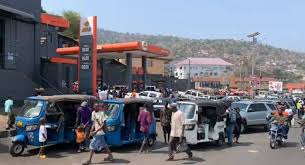
On 2 April 2026, the Government of Sierra Leone announced a temporary fuel subsidy, capping petrol at NLe 35 per litre and diesel at NLe 40 per litre for a fortnight. Without that intervention, the full market formula would have pushed petrol to NLe 36.10 and diesel to a staggering NLe 44.26. The government absorbed the difference to shield citizens from the full fury of a global energy shock that has absolutely nothing to do with them.
That subsidy expires on 15 April. And the war that caused it shows no sign of ending.
Since the United States and Israel launched Operation Epic Fury against Iran on 28 February, the Strait of Hormuz, through which roughly a fifth of the planet’s petroleum flows each day, has been effectively shut down. Iran’s retaliatory strikes on vessels and energy infrastructure across the Gulf have produced what the International Energy Agency has called the greatest global energy security challenge in history. Brent crude has surged past $115 a barrel, nearly double the price upon which Sierra Leone’s 2026 budget was built.
The consequences for Sierra Leone are as predictable as they are cruel. In a country that imports every single drop of refined fuel it consumes, a global oil shock is not an abstract macroeconomic event. It is the price of a cup of rice at Abacha Street market. It is the fare on a poda-poda from Wellington to PZ. It is the cost of running the diesel generator that keeps a clinic’s refrigerator cold in Bo or Kenema. It is the difference between a child eating twice a day and eating once.
When fuel prices rise in Sierra Leone, the price of everything else follows. Fuel powers the trucks that carry goods from Freetown port to markets upcountry. It runs the motorcycles and minibuses that move millions of people daily. It fuels the generators that provide electricity where the national grid cannot reach, which is most of the country. Every Leone added to the price of diesel cascades through the entire cost chain, transport fares climb, market women raise their prices to cover haulage, and small businesses operating on razor-thin margins simply close.
We have seen this before. During the Russia-Ukraine crisis of 2022, Sierra Leone endured inflation that peaked at a punishing 47.7 per cent. It took two painful years of sacrifice, by ordinary people more than anyone, to bring that figure down to 4.4 per cent by October 2025. That achievement is now under direct threat from a war being waged eight thousand kilometres away by nations whose citizens will never feel a fraction of the hardship their governments are inflicting on ours.
The projections paint a sobering picture. Inflation could rebound to between 15 and 20 per cent. If the conflict persists through the year, it could soar back towards 28 to 40 per cent. Growth, budgeted at 4.6 per cent, could stagnate to near zero. Foreign exchange reserves, already perilously thin at 1.7 months of import cover, could fall below a single month, making it extraordinarily difficult to pay for essential imports.
But statistics do not capture the human reality. Consider the market woman in Lumley whose transport and wholesale costs have already risen while her customers buy less. Consider the Okada rider in Makeni whose daily fuel cost has jumped by a fifth, but who cannot raise fares without losing passengers. Consider the farmer in Kambia preparing for the April planting season, only to find that fertiliser, much of which originates from Gulf producers now cut off by the Strait of Hormuz, has climbed beyond reach. If that farmer cannot plant, Sierra Leone’s progress towards rice self-sufficiency under the Feed Salone programme will reverse, and the country will import more food, at higher prices, in a weakening currency.
In a nation where extreme poverty exceeds 50 per cent and food insecurity affects roughly 80 per cent of the population, there are no private safety nets, no savings accounts to draw upon, and no second incomes to fall back on. The margin between survival and crisis is measured in single-digit leones.
Sierra Leone is not alone. Across the developing world, oil-importing nations are scrambling. Last Friday, Senegal’s Prime Minister Ousmane Sonko banned all non-essential foreign travel by government ministers, cancelled his own planned trips abroad, and warned of extremely difficult times ahead. Senegal’s budget was built on oil at $62 a barrel; the market now trades at nearly double that. Pakistan has imposed a four-day working week for public offices. Bangladesh has ordered shopping centres to close by eight o’clock in the evening. These are the collateral casualties of a conflict they had no part in starting and no power to stop.
What makes this moment particularly bitter is the timing. Sierra Leone had begun to turn a corner. The FY2026 budget emphasised domestic revenue mobilisation and reduced dependence on aid. Feed Salone was delivering measurable results, with rice self-sufficiency said to be reaching 72 per cent. The IMF programme was on track. Over 800,000 children were benefiting from school feeding. Civil servants were promised a salary increase. Twenty thousand of the poorest households were to receive cash transfers. All of this is now at risk, not because of any policy failure in Freetown, but because of decisions made in Washington and Tel Aviv.
The temporary fuel subsidy was a necessary act of compassion, but it is not a solution. At an estimated cost of roughly NLe 63 million for just fourteen days, extending it indefinitely would devour the fragile fiscal surplus that underpins the entire budget framework. No developing country can subsidise its way through a prolonged global energy crisis.
What Sierra Leone needs, what all vulnerable nations caught in this crossfire need, is for the international community to recognise that the costs of this war are not being borne equally. The nations waging it have strategic petroleum reserves, diversified energy sources, and the fiscal capacity to cushion their populations. We have none of these things. When the World Food Programme warns that the Iran conflict could push 45 million additional people globally into acute food insecurity, it is talking about people like us.
The government must act with speed and discipline. It must engage urgently with the IMF to secure programme flexibility, ring-fence social protection spending against any fiscal cuts, urgently procure fertiliser from alternative sources before the planting window closes, and communicate honestly with the public about what lies ahead. These are not optional. They are survival imperatives.
But beyond macroeconomic management lies a deeper moral question that Sierra Leoneans are right to ask: why must we bear the burden of a war we did not choose, fought by nations far richer than ours, over disputes that have nothing to do with our lives?
The petrol seller at the junction, the nurse commuting to Connaught Hospital, the student walking to school because her parents can no longer afford the bus fare, none of them had a seat at the table when this war was planned. None of them was consulted. None of them will be compensated.
They deserve better. They deserve, at the very minimum, to be seen.