
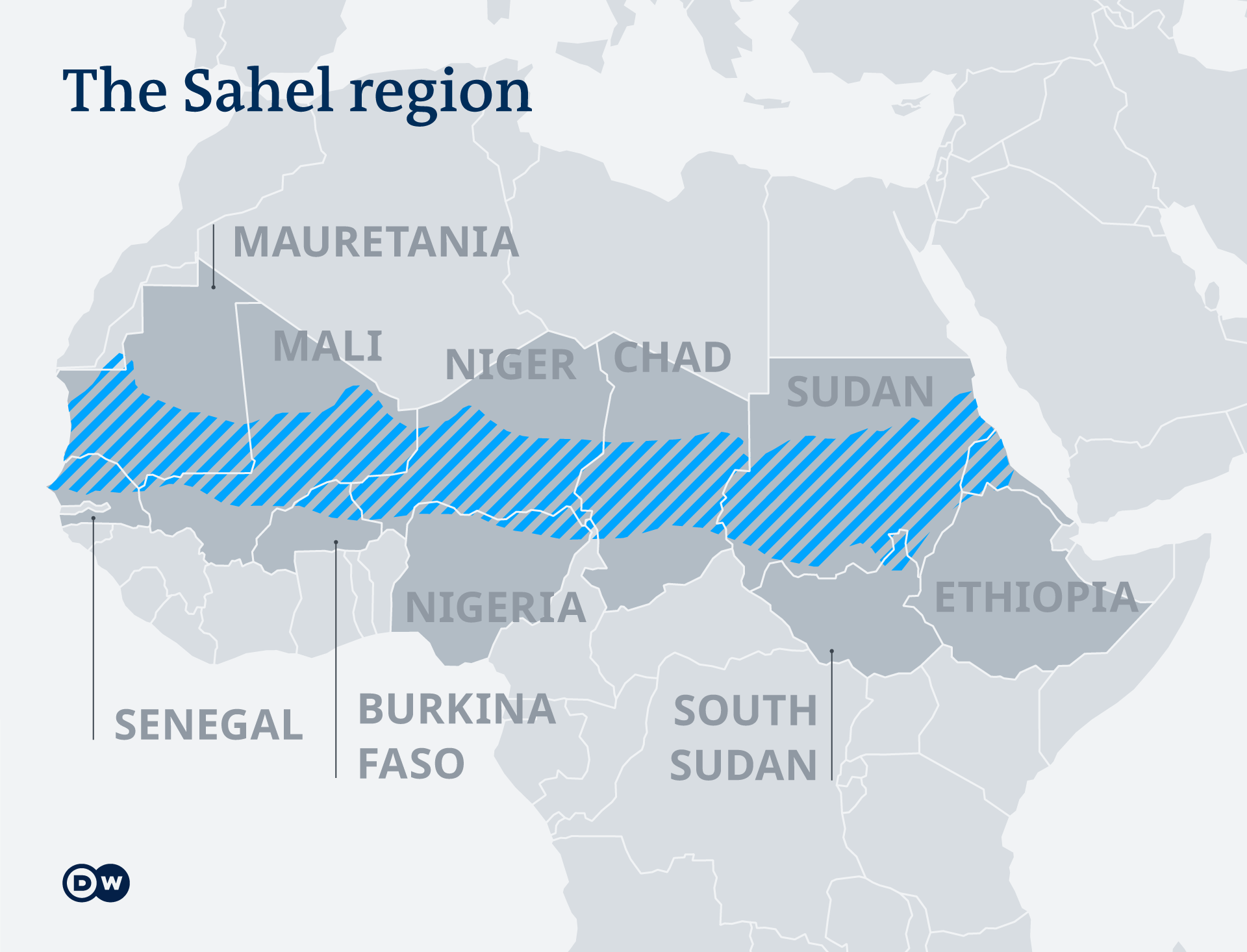
In the small hours of Saturday, 25 April 2026, a suicide car bomb tore through the residence of Mali’s Defence Minister, General Sadio Camara, in the garrison town of Kati. He died with his second wife and two children. By the end of the weekend, his army’s intelligence chief, General Modibo Koné, had also succumbed to wounds sustained in the same firefight. Across Mali, in Bamako’s airport district, in Sévaré and Mopti, in Gao and Kidal, Al-Qaeda’s Sahel franchise, JNIM, and the secular Tuareg-led Azawad Liberation Front (FLA) had launched the most ambitious coordinated offensive on the Malian state since 2012.
Within forty-eight hours, the FLA flag was flying over Kidal. A negotiated convoy of Russian Africa Corps mercenaries was filmed leaving the town under FLA escort, setting the camp on fire behind them. Junta leader General Assimi Goïta, invisible since the first explosion, evacuated to a special-forces base and had gone to ground. JNIM’s spokesman, in a Bambara-language video circulated within hours, declared a “total siege” on the capital and warned civilians not to position themselves between his men and the Malian army.
This is not yet the fall of Mali. But it is the loudest possible verdict on the political economy of the past five years in the central Sahel and a warning that no honest West African capital, Freetown included, can pretend not to hear.
A verdict, not a surprise
Nothing about the weekend’s offensive was inevitable, but everything about it was foreseeable. Since the 2020 and 2021 coups, Mali’s military rulers have presided over a steady inversion of the bargain they offered their citizens: take our boots, our curfews and our deferred elections, and we will give you security. Instead, the country has lost more territory, buried more soldiers and seen more civilians displaced under the junta than under the imperfect democracy it overthrew. The 2015 Algiers peace accord with Tuareg movements was unilaterally torn up in 2024. The United Nations was shown the door. France was expelled. Russia’s Wagner Group, rebranded as Africa Corps, was invited to fill the vacuum , and has spent two years compiling a record of civilian abuses now compounded by a humiliating, negotiated withdrawal from Kidal.
Sadio Camara was no peripheral figure in any of this. He was, as the Dakar-based analyst Gilles Yabi has noted, the principal architect of the regime’s strategic partnership with Moscow and one of the five colonels-turned-generals who have run Mali since the May 2021 coup. His killing in his own bedroom is therefore more than a personal tragedy; it is a structural blow to the Russian-Malian arrangement that has substituted for a national security strategy since 2022.
Nor was Mali’s predicament merely a matter of bad strategic choices in Bamako. From September 2025, JNIM imposed a fuel blockade that brought the capital to a standstill and forced the closure of schools and universities by late October. By March 2026, the junta was reduced to negotiating a quiet truce, with a hundred prisoners reportedly freed in exchange for a temporary lifting of the siege. The “extraordinary success” the regime continues to advertise on state television is contradicted by every credible monitor. The bombs that found Camara in his bedroom have settled the argument.
What is genuinely new is the open coordination between JNIM and the FLA. These were uneasy bedfellows in 2012, before the jihadists turned on the separatists and routed them. Their ambitions remain irreconcilable in the long run, a caliphate is not an independent Azawad, and an FLA whose forerunners once fought alongside French troops is no natural ally of an Al-Qaeda franchise. But for now, pragmatism has produced something the region has not seen at this scale, a tactical alliance with the firepower, manpower and, disturbingly, the logistics, the FPV kamikaze drones and the planning to strike six locations simultaneously across a country twice the size of France.
The two scenarios now on the table
Most analysts of the central Sahel are no longer arguing about whether Mali will deteriorate further. They are debating the shape of that deterioration. Gilles Yabi, founder of the West African citizen think tank WATHI, has set out two worst-case scenarios that must now be treated as probable rather than alarmist.
The first is what some have already begun calling a Somalisation of Mali, a slow institutional, military and political decomposition over years rather than weeks, with the formal state surviving in name while territorial control fragments among armed groups, foreign mercenaries, traditional authorities, criminal networks and pockets of regular-army loyalty. The second is the more dramatic prospect of a takeover of central political power by a coalition that fuses JNIM, the FLA, opportunistic defectors and the residue of the Goïta security state in the absence of any credible alternative. JNIM’s increasingly public emphasis on its own Syria-style parallel governance, courts, taxation, and policing in the territories it already controls suggests it has been thinking about this scenario for some time.
Either outcome is a disaster for West Africa. And it is worth saying plainly: neither will be averted by Mali’s notional partners in the Alliance of Sahel States. The military regimes in Ouagadougou and Niamey are not bystanders to the central Sahel’s unravelling; they are co-authors of it, having made the same strategic choices on French withdrawal, UN expulsion, Russian dependency and the criminalisation of dissent. The AES cannot rescue Mali, because the AES is the same political project that brought Mali to this weekend.
Why Freetown should be reading the cables
It is tempting to file Mali under “tragedies that happen elsewhere.” That instinct is wrong on at least two counts.
The first is geopolitical. The southward drift of Sahelian jihadism is no longer a forecast; it is a pattern. JNIM’s Katiba Hanifa killed more than seventy Beninese soldiers in coordinated assaults on military posts in 2025, the deadliest single incident in northern Benin in over a decade. Togo has absorbed repeated incursions into its Savanes region. Northern Ghana and Côte d’Ivoire’s forest reserves are now mapped, in serious counter-terrorism literature, as transhumance corridors and rear bases. By the close of 2025, JNIM incursions into northern Benin, Togo and Ghana were sufficiently routine that maritime authorities in Lomé and Cotonou had begun integrating coastal radar with northern border sensors. The Gulf of Guinea littoral is no longer a buffer; it is a frontier.
The second reason is structural, and it is closer to home. The conditions that made Mali combustible , chronically weak service delivery in peripheral regions, the marginalisation of pastoralist and minority communities, intercommunal grievances exploited by armed entrepreneurs, fiscal centralisation and capital-centric politics , are not unique to the Sahel. They are present, in various dilutions, across West Africa. Sierra Leone is mercifully far from the tri-border zone. But porous borders, an under-resourced security sector, a youth bulge in chronically underdeveloped districts, and a regional architecture that has just lost three of its hardest-hit members are not abstractions. They describe our neighbourhood.
President Bio’s Test
President Julius Maada Bio inherited the chairmanship of the ECOWAS Authority in June 2025 at a moment when nearly half of the bloc’s original members had experienced military takeovers in the previous decade and three, Mali, Burkina Faso and Niger, had formally departed for the Alliance of Sahel States. He has, to his credit, articulated a coherent four-pillar agenda: restoring constitutional order, strengthening regional security cooperation, accelerating economic integration and rebuilding institutional credibility. He has resisted the temptation to write the AES off, telling the African Union’s Special Representative for Mali and the Sahel as recently as March that the reintegration of the three states is “in the long-term interest of the region”. At the Munich Security Conference in February, he framed the Sahel crisis as a test of genuine, undistracted engagement rather than geopolitical theatre. In Freetown that same month, ECOWAS defence chiefs finally formalised a 2,000-strong Standby Force.
These are necessary positions. They are not yet sufficient. The April attacks expose three uncomfortable truths that the Bio chairmanship must confront before its one-year clock runs down.
First, ECOWAS condolence statements cannot substitute for a security architecture. The bloc’s response to the weekend’s events , a press release calling on member states to mobilise in a coordinated effort against terrorism , is not commensurate with a Defence Minister’s assassination, the loss of Kidal or JNIM’s siege rhetoric. The Standby Force, promised for end-2026, must be operationalised on a faster timetable, with intelligence-sharing protocols, joint exercises and a clear activation doctrine that does not require political unanimity in a twelve-member bloc on every deployment decision.
Second, the AES exit cannot be treated either as a permanent estrangement or as an excuse for inaction. Because the AES junta cannot save itself, a credible response will have to be coordinated externally, most plausibly by the African Union in concert with West African leaders, with President Bio’s ECOWAS providing the political muscle and the operational backbone. A coastal-states track, Côte d’Ivoire, Ghana, Togo, Benin and Nigeria, with Sierra Leone and Senegal as facilitators, is overdue. The five-nation ECOWAS arrangement (Côte d’Ivoire, Ghana, The Gambia, Liberia and Sierra Leone) is a foundation, not a finished product. The narrative that the Gulf of Guinea is post-piracy must give way to a recognition that it is pre-something else.
Third, and most uncomfortable for those of us who write about politics rather than gunfire: there is no sustainable counter-terrorism without a counter-grievance agenda. The Carnegie Endowment’s verdict on Russia in Mali, a heavy military hand without a political strategy to address the root causes of violence, applies, in different uniforms, to fourteen years of French, UN, American and now Russian interventions. The question for Freetown and Abuja is whether ECOWAS can avoid that trap by investing in the unglamorous infrastructure of legitimacy: courts that work, schools that open, public services that reach beyond the tarmac, taxes that are paid and seen, and borders that are governed rather than performed.
There is a final consideration that ought to register in Freetown more sharply than anywhere else. Even as Mali burns, its gold will keep moving. The Democratic Republic of the Congo has demonstrated, over decades, that minerals exit chaos almost as efficiently as they exit peace. Sudan is demonstrating it again, in real time, while a genocide unfolds. The lesson for a Sierra Leone whose growth story is bound up with iron ore, gold and rutile is that the global economy can absorb a great deal of West African disorder without losing its appetite for what we sell. The market will not save our governance. Only we can.
That is also why the Gilles Yabi diagnosis, set down in Dakar last November and reaffirmed this week, has earned its hearing. He warned that the colonels-turned-generals were committing what he called a “sovereign suicide in pride,” and that the bill would be paid not in Bamako alone but across the region. The events of 25 April have, depressingly, vindicated him.
For the senior diplomats now drafting condolence cables to Bamako, the Mali offensive is at least a useful clarifier. It has rendered indefensible the proposition that mercenaries and curfews are a substitute for politics. It has been shown that JNIM’s parallel-governance ambitions are no longer hypothetical. It has confirmed, with awful efficiency, that the line between an inland insurgency and a regional crisis is a matter of months and motorbikes.
For Sierra Leone, the lesson is more practical and more painful. Our democratic gains, hard-won and incomplete, depend not only on what we do at home but also on what holds together around us. President Bio did not ask for this crisis. He cannot avoid being judged by his response to it.
Bamako is burning but the coast cannot look away.