
For sixteen years, Viktor Orbán was the world’s favourite cautionary tale. He was also, for a certain class of strongman, the world’s favourite instruction manual. From Budapest, he showed how a leader could keep the outer shell of democracy – elections, a parliament, a constitution, even a free-ish press – while quietly removing everything inside that made it work. Courts captured. Media starved of advertising. Electoral maps redrawn with surgical precision. Civil society painted as foreign agents. The polls still opened every four years. Orbán still won. And the world, gradually, came to accept this as the new normal for democracy in retreat.
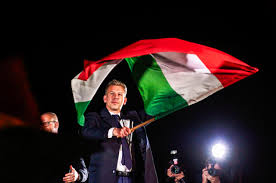
On 12 April 2026, Hungarian voters tore that manual in half. Turnout touched nearly 80 percent. Péter Magyar’s Tisza party swept 138 of 199 parliamentary seats — a two-thirds supermajority large enough to rewrite the very constitution Orbán spent a decade bending to his will. Orbán himself conceded before dawn, calling the result “painful but clear.” The system he had spent sixteen years perfecting did exactly what it was designed to do: it delivered a landslide. He just wasn’t the beneficiary.
Every African capital where “democracy” has been reduced to a ceremonial word on the letterhead should read that sentence twice.
The comfortable lie of the captured state
There is a story that autocrats in our region tell themselves, and it runs roughly like this, capture the judges, and no court will overturn your election. Capture the electoral commission, and the numbers will land where you need them. Capture the press, and the story will be the one you wrote. Capture the security services, and the streets will stay quiet when they should not be. Do all of this patiently, and democracy becomes a costume you can wear forever.
It is a seductive theory. It is also, as Hungary has just demonstrated to the world, a lie.
Orbán captured more of his state than any leader in Benin, Guinea, Togo, Uganda, Rwanda, Cameroon or Zimbabwe has ever managed to capture of theirs. He had a gerrymandered electoral map designed by his own lawyers. He had a state broadcaster that functioned as a party bulletin. He had a constitutional court stacked with loyalists, an electoral commission he appointed, oligarchs who owned the private newspapers, and a patronage network that reached into every village. He had the endorsement of the current American president and a last-minute campaign visit from the American vice-president. On paper, he was unbeatable.
He lost by a landslide so large his opponent said it was “visible from the moon.”
The lesson is not that Hungary’s institutions were secretly healthy. They were not. The lesson is sharper and more uncomfortable for every ruler who thinks he has mastered the Orbán playbook: captured institutions tilt the field, but they do not reverse gravity. When a population is angry enough, organised enough, and presented with a credible alternative, a rigged system can still produce the one result the riggers feared most.
Why this matters
Look around the continent. In Benin, once celebrated as a West African democratic success story, President Patrice Talon systematically engineered out meaningful opposition, with leading challengers jailed, exiled or disqualified before they can ever reach a ballot paper. In Togo, a constitutional manoeuvre has quietly converted a hereditary presidency into a parliamentary one while leaving the same family in charge. In Uganda, Tanzania, Rwanda, Zimbabwe and beyond, the forms of democracy are observed while its substance is hollowed out.
These are not democracies in difficulty. They are, to borrow the phrase political scientists now use for what Orbán built, competitive authoritarian regimes, to wit, systems where elections happen, but where the playing field is tilted so steeply that opposition is a performance rather than a possibility.
The African incumbents who have copied parts of Orbán’s architecture should draw a cold conclusion from his fall. The model does not expire quietly. It expires all at once. Voter frustration over corruption, the cost of living, collapsing public services and the arrogance of power does not dissipate simply because the evening news refuses to report it. It accumulates. And when it finally moves, it moves in numbers that no gerrymander can absorb.
What the opposition in Budapest got right
Péter Magyar did not win by out-shouting Orbán on the culture war. He won by refusing to fight on that battlefield at all. He ran on potholes, on hospitals that could not keep the lights on, on teachers who had not been paid, on the obscene villas of regime-connected oligarchs. He was himself a former Fidesz insider, which made him almost impossible to dismiss as a stooge of Brussels or Kyiv, though the state media tried. He united voters who agreed on little else except that the current arrangement could not continue. And critically, he persuaded the politically exhausted, the citizens who had given up on voting, that this time, turning out would actually matter.
There is a playbook in that. It translates. Close ranks behind one credible challenger, not a committee of seven. Campaign on bread and electricity and stolen money, not on abstractions. Recruit defectors from within the regime, because nothing delegitimises a captured state faster than the testimony of the people who helped capture it. Treat elections as real battles to be organised for, not rituals to be denounced. And above all, refuse the incumbent’s favourite gift — the boycott — which hands him the victory he could not otherwise guarantee.
A warning, and a window
Orbán’s fall is not a prophecy. Africa’s illiberal regimes have tools he did not, deeper ethnic cleavages to exploit, weaker regional pressure, more pliant international partners, security services less constrained by the appearance of European norms. Some will read his defeat and tighten their grip rather than loosen it, banning more parties, arresting more journalists, pushing elections further into the future. That is already beginning.
But the window his defeat opens is real, and it should not be allowed to close unnoticed. The aura of inevitability that illiberal rulers cultivate is their single most valuable asset. It is what persuades the civil servant to comply, the judge to rule the wrong way, the voter to stay home, the donor country to shrug. Hungary has just punctured that aura on a continental scale. Every opposition leader, every civil society organiser, every editor and every voter from Conakry to Kampala to Harare now has fresh evidence, in high resolution, that the game is not actually fixed, only tilted. And tilted games can still be won.
Sixteen years is a long time to wait. Benin has waited. Guinea is waiting. Others will wait longer still. But the central lesson from Budapest is one this paper has argued before and will argue again, democracy is not a building that autocrats tear down overnight. It is a muscle that atrophies when citizens stop using it and returns, surprisingly quickly, when they do.
Viktor Orbán built the most sophisticated machine for managing elections that Europe has seen in a generation. On a Sunday in April, his own voters switched it off. Africa’s strongmen should sleep a little less comfortably tonight. And Africa’s democrats should sleep with the curtains open.