
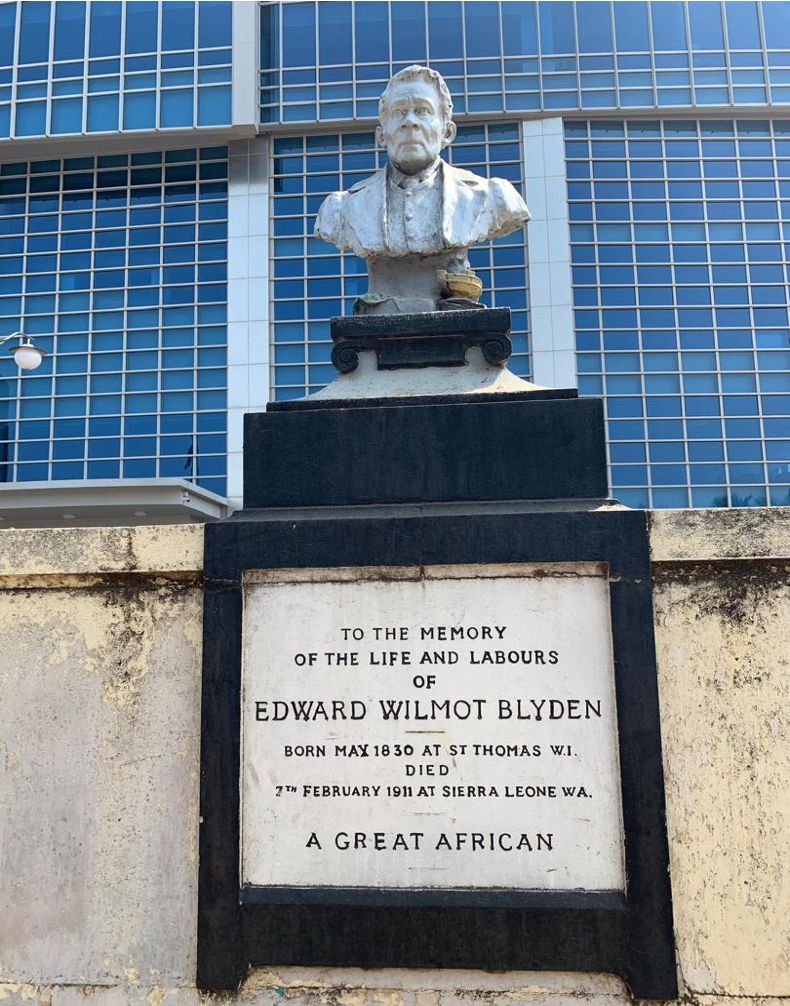
The afterlife of Edward Wilmot Blyden reveals, with unusual clarity, that remembrance is never a neutral act. It is a political project—an arena in which competing communities struggle to define not only who the dead were, but what they mean. In Blyden’s case, this struggle is inscribed materially in stone: in the divergence between his gravestone, erected by his “African friends,” and a commemorative tablet in central #Freetown installed by his “white friends.” That these memorials record different dates of his passing is not merely an archival inconsistency. It is symptomatic of a deeper contest over authority, belonging, and racial meaning. Even in death, race contoured Blyden’s memory.
The gravestone is intimate, declarative, and political. It names Blyden “A Truly Great African,” situating him within a moral and intellectual community that claims him as its own. The inscription collapses the geography of the Black Atlantic—St. Thomas, Liberia, Sierra Leone—into a narrative of return and belonging, while affirming an identity that Blyden himself spent a lifetime elaborating: Africa as both cultural inheritance and political destiny. Erected by “his African friends and admirers,” the grave speaks in a voice of proximity. It is grounded in lived relations, in recognition, and in a shared understanding of Blyden as a race man—one whose intellectual labour was inseparable from the project of African self-definition.
By contrast, the tablet in the center of Freetown belongs to a different memorial regime. Its location in a colonial civic space and its attribution to “white friends” immediately signal a distinct audience and purpose. Here, Blyden is reframed—rendered legible within the categories of empire: a learned man, a respectable figure, perhaps even a loyal subject of imperial modernity. The discrepancy in the date of death is telling. It suggests a memorialization at a distance, mediated through bureaucratic or symbolic registers rather than grounded knowledge. More importantly, it underscores the limits of colonial authority over the very lives it sought to classify. If the grave embodies recognition, the tablet performs inscription—an attempt to fix Blyden within an imperial archive that cannot fully contain him.
These two memorials do not simply differ; they speak past one another. They constitute two voices on Blyden, each racializing his life in distinct ways. The gravestone asserts him as African, not as a descriptive category but as a political identity forged against the hierarchies of race that structured the nineteenth-century Atlantic world. The tablet, by contrast, risks domesticating that radicalism, translating Blyden into a figure acceptable within colonial discourse. In doing so, it participates in the production of historical silences—not by erasing Blyden, but by reconfiguring the terms through which he is remembered.
To grasp the significance of this divergence, one must situate Blyden within the broader crisis of Black Atlantic modernity. As a thinker, he was deeply invested in the question of race—not as a biological essence, but as a historical and cultural formation requiring defence, cultivation, and dignity. Blyden’s project was to reclaim Africa from the epistemic violence of empire, to assert the value of African civilisations, and to imagine a future in which Black people could exist outside the tutelage of Europe. Yet his life was also entangled with the institutions of empire—missionary networks, colonial administrations, and settler societies in Liberia and #SierraLeone. This dual positioning made him, even in life, a contested figure.
It is therefore unsurprising that his death did not resolve these tensions but instead reactivated them in the domain of memory. The gravestone and the tablet reproduce, in miniature, the larger contradictions that structured the Black Atlantic world: between autonomy and incorporation, between race consciousness and imperial recognition, between lived community and administrative abstraction. Memory here is not a passive record but an active site of struggle.
The discrepancy in dates—seemingly minor—can be read as a profound metaphor. It signals that there is no single authoritative account of Blyden’s life or death. The archive is unstable; the record is incomplete. More importantly, it reveals that the power to remember is also the power to define reality. In this sense, remembrance becomes an extension of politics by other means. To name Blyden, to date his death, to situate him within a narrative—these are acts that carry ideological weight.
The memorialization of Blyden poses a central question: what kind of past is being constructed and for what purposes? The gravestone constructs a past oriented toward African self-assertion and collective dignity. The tablet constructs a past compatible with colonial order and recognition. Neither is neutral; both are interventions in the present.
To say that even in death race contoured his memory is to recognize that race operates not only in life but in the afterlives of historical figures. It shapes who claims them, how they are represented, and what they are made to signify. Blyden’s body lies in Sierra Leone, but his memory circulates across competing discursive fields, each seeking to fix its meaning. The result is not a singular legacy but a contested one—one that exposes the politics of remembrance itself.
In the end, these memorials do more than commemorate Blyden. They reveal the impossibility of stabilizing his meaning within a single narrative. They show that remembrance is always an act of power, that memory is always already political, and that the struggle over race does not end with death. Blyden remains, even in memory, a figure claimed, reinterpreted, and contested by the very worlds he sought to transform.
Ibrahim Abdullah lectures at Fourah Bay College
Image