
The case of Fatmata Kamara is not an isolated injustice; it is the system working exactly as petty offence laws were designed to work. It is time to repeal them.
Based on news reports, on 18 March 2026, a Freetown Magistrate Court sentenced Fatmata Kamara, a fry fry seller at New Jersey Junction, Goderich, to two months in prison. Her crime? Speaking rudely to a customer, she did not serve quickly enough. That customer turned out to be a magistrate. She did not know. Magistrates have no uniform. He was not on duty and not performing any official function. He was simply a man waiting for food.
We tried to access the court file but to no avail. Yet based on information we have garnered, the full weight of the criminal justice system was brought down on her. We were informed that a private prosecution was instituted bypassing the police entirely. She faced two charges under the Public Order Act 1965, a near-maximum sentence, and a judicial lecture about disrespecting “a high-level citizen of this country in the capacity of a magistrate.” The capacity we believe of a magistrate, at a fry fry stall, in plainclothes, buying lunch.
This case should disturb every Sierra Leonean who believes in equal justice. It is not merely an instance of harsh sentencing. It is a case study in how petty offence laws are weaponised against the poor, the powerless, and the informal, and why they must be abolished.
Fatmata Kamara was convicted under Sections 2 and 3 of the Public Order Act 1965, “public insult and provocation” and “insulting conduct.” These provisions make it a criminal offence to use language in public that is “likely to provoke a breach of the peace.” They are vaguely drafted, subjectively enforced, and carry prison time for what amounts to being rude.
No breach of the peace occurred in this case. The magistrate left the stall. Nobody was hurt. Nobody was threatened. A woman at her place of work exchanged sharp words with a customer, something that happens at market stalls across Freetown every single day. The difference is that this customer had access to the courts in a way Fatmata Kamara never will.
Consider the procedural facts. We believe Magistrate Aaron Bangura did not report the matter to the police. There was no investigation, no caution, and no public-interest assessment. He brought a private prosecution directly before a fellow magistrate. One judicial officer complained; another convicted. The entire process, from complaint to conviction to imprisonment, took place within the judicial family, with an ordinary market woman on the receiving end.
When the sentencing magistrate, Solomon Christian Kekurah, explained the severity of the punishment. He declared that the insults were “directed to a high-level citizen of this country in the capacity of a magistrate.” But the Public Order Act does not create a special offence of insulting a magistrate. It does not provide enhanced penalties based on the victim’s rank. He made the sentences consecutive, though, as a rule of thumb, consecutive sentences are not imposed for offences that happened at the same time and place. The sentencing remarks reveal what was really happening. The criminal law was being used not to protect public order, but to enforce deference to judicial status. That is abuse of process, plain and simple.
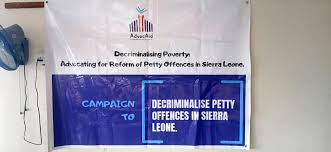
None of this will surprise the organisations that have spent years documenting exactly this pattern. Since 2019, AdvocAid, the Freetown-based legal aid organisation, together with the Centre for Accountability and the Rule of Law (CARL) and members of the Regional Campaign to Decriminalise Petty Offences in Africa, has campaigned for the repeal of provisions like Sections 2 and 3 of the Public Order Act.
Their research is damning. A 2019 study of Magistrate Court records found that a third of all cases were petty offences. Over 90 per cent of those charged were unemployed or low-income informal workers, market women, Okada riders, street traders. The Freetown Male Correctional Centre was at 802 per cent of its designed capacity, swollen with people imprisoned for loitering, minor debt, and “insulting language.” The position paper co-authored by AdvocAid and CARL concluded bluntly “The poorer you are, the closer you are to jail.”
In November 2024, AdvocAid and the Institute for Human Rights and Development in Africa (IHRDA) won a landmark judgment at the ECOWAS Community Court of Justice. The Court declared Sierra Leone’s loitering provisions under the Public Order Act unlawful, discriminatory, arbitrary, and in violation of the rights to equality, non-discrimination, and freedom of movement. The Court ordered the government to repeal or amend the offending laws. The same constitutional and human-rights reasoning applies with equal force to the “insulting conduct” provisions used to imprison Fatmata Kamara.
Let us be clear about what is at stake. The question is not whether rudeness is acceptable. Nobody is arguing that Fatmata Kamara’s words to her customer were polite. The question is whether rude words at a food stall should be a criminal offence carrying prison time, and whether that criminal process should be available as a personal weapon to powerful individuals who feel slighted in their private lives.
The answer, in any society that takes equality before the law seriously, must be no. Civil remedies exist. Mediation exists. Community mechanisms exist. What should not exist is a system in which a magistrate who is unhappy with his service at a fry fry stall can, without police involvement, without any public-interest filter, have the seller locked up for two months.
This is not justice. This is the criminalisation of poverty and powerlessness, dressed in the language of public order.
The ECOWAS Court has spoken. AdvocAid, CARL, and their partners have done the research, built the case, and secured the legal precedent. What remains is political will.
The Honourable Chief Justice who has power of review must review this case. Parliament must act. The Public Order Act 1965, including its vague and abusive “insulting conduct” provisions, must be reviewed and reformed. Sections that criminalise speech, poverty, and everyday human friction must be repealed. Non-custodial alternatives for genuinely disorderly conduct must replace the reflexive resort to imprisonment. The private prosecution route must include a public-interest safeguard so that it cannot be used, as it was here, as a tool of personal retribution.
Fatmata Kamara is in prison today because she was rude to a man she did not know was a magistrate. She will serve two months, not because she threatened anyone, not because she breached anyone’s peace, but because she lacked the status and the power to defend herself against laws that were designed, sixty years ago, to keep people like her in their place.
If that does not demand legislative change, nothing will.