
Book Review
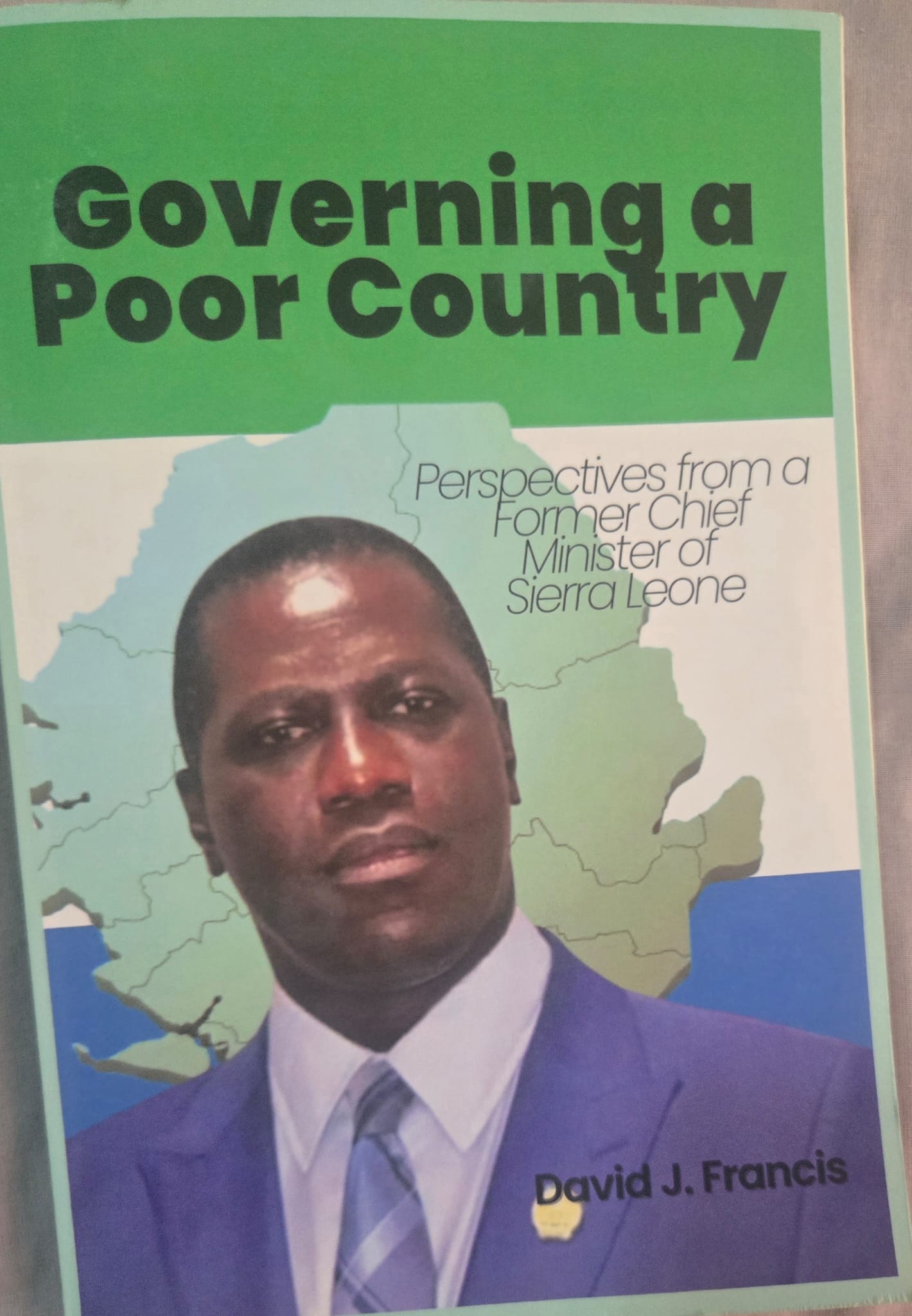
Governing a Poor Country: Perspectives from a Former Chief Minister of Sierra Leone
Professor David J. Francis
Published 2025 | 140 pages| Adonis & Abbey Publishers Ltd
In March 2020, SierraEye published an article that asked a blunt question under the headline “Pres. Bio Leading But Not in Charge?” The article challenged the constitutional legitimacy of the Office of the Chief Minister and argued that the position resembled that of a Prime Minister in a presidential system.
In pages 128 and 129 of the book, Francis writes that after the article appeared, he noticed a cooling in his relationship with President Bio, who began to distance himself “from our otherwise close, amicable, and positive governance working relationship.” SierraEye would be flattered if it possessed such influence. However, the controversy which followed placed Professor David J. Francis, Sierra Leone’s first Chief Minister since independence, at the centre of national debate.
Five years later, Francis responds. His answer arrives not through press statements or political speeches but through a short, dense 140-page book. Governing a Poor Country serves as a rebuttal, a memoir, a governance manual, and a political reflection.
SierraEye appears several times in the book. Francis treats the magazine as both critic and participant in the public debate surrounding his office. Readers familiar with the 2020 controversy will recognise many of the arguments which shaped national discussion during that period.
This book performs four distinct roles.
First, Francis presents a constitutional history of the Office of Chief Minister. He traces the position from its colonial origins in 1954 through its disappearance after the 1971 Republican Constitution and its re-creation by President Julius Maada Bio in 2018.
Second, the book works as a governance manual. Francis describes the systems, delivery mechanisms, and coordination frameworks he introduced during his three years in office.
Third, the book functions as a political memoir. Francis recounts his personal transition from professor at Bradford University to one of the most powerful offices in the Sierra Leone executive.
Fourth, the book stands as a primary record for future historians seeking insight into how the New Direction government operated during its first term.
Francis makes no claim of neutrality. He writes as an insider who participated in the events he describes. He openly labels his method “policy-practice critical reflection.” Readers searching for detached academic analysis will struggle. Readers seeking first-hand testimony from inside government will find rich material.
Francis begins with a troubling national paradox. Sierra Leone possesses diamonds, gold, bauxite, rutile, iron ore, lithium, rare earth minerals, and other valuable resources. The country produced famous stones such as the Star of Sierra Leone and the Peace Diamond. Yet Sierra Leone ranks near the bottom of the United Nations Human Development Index.
Francis argues that the explanation lies in leadership failure rather than resource scarcity.
The comparison with South Korea delivers the book’s sharpest point. At independence in 1961, international observers viewed Sierra Leone as more promising than South Korea. Six decades later, the contrast is dramatic. South Korea commands one of the largest economies in the world. Sierra Leone remains among the poorest nations.
Francis attributes this divergence to a system of governance built around neo-patrimonial politics. State resources merge with private accumulation. Political office becomes a route to enrichment. The famous phrase attributed to President Siaka Stevens captures this culture. “Where a cow is tethered, there it grazes.”
SierraEye readers will recognise this diagnosis. The magazine has documented similar patterns for years. Francis adds something different. He offers a view from inside government and describes the resistance faced by anyone attempting institutional reform.
When Francis entered State House in 2018, he encountered a surprising reality. The Office of the Chief Minister lacked a job description, terms of reference, or administrative framework. The position existed in name only.
Francis stated that he designed the office from the ground up.
He established six core functions for the institution. He introduced a Ministerial Performance Management system tied to the government’s eight national priorities. Cabinet retreats encouraged strategic planning. Presidential executive orders attempted to restore discipline in public service. A National Monitoring and Evaluation Directorate tracked performance across ministries and agencies.
Francis also chaired the Governance Transition Team which investigated the state inherited from the previous administration. The report described a government burdened with heavy debt and systemic corruption. According to Francis the findings triggered political hostility and personal threats against him.
Francis devotes significant attention to the constitutional dispute raised in SierraEye’s 2020 article.
His argument rests on sections of the 1991 Constitution which grant the President authority to appoint ministers beyond the Vice President. Parliament approved the appointment, and the Speaker of Parliament confirmed its legality during debate in the chamber.
Francis rejects the claim that the Chief Minister served as the Prime Minister. He presents the role as an administrative coordinator responsible for implementing presidential decisions across ministries.
The constitutional argument appears convincing on paper. Yet Francis’s own narrative raises a deeper question. If the Chief Minister depended on presidential authority to enforce decisions, what happened when such backing weakened or disappeared?
The book provides several revealing examples.
Some of the book’s strongest passages describe practical governance failures.
Francis commissioned a Standard Operating Procedures report for the Presidency with support from the Tony Blair Institute and the British High Commission.
The report proposed professional administrative structures for State House. The Office of the Secretary to the President quietly shelved the document. No implementation followed.
Another episode involved a scheduling breakdown in which the President appeared to be booked for two major events at the same time. Such incidents exposed weaknesses within the administrative machinery of the presidency.
Francis also introduced ministerial performance contracts and a warning system for underperforming ministers. He issued formal “yellow cards” to several officials and recommended four for dismissal. The President declined to act on these recommendations.
Without enforcement power, the performance system lost practical value.
Other initiatives faced similar obstacles. National Cleaning Day began as a popular civic campaign. Political rivalry and commercial interests undermined the programme. COVID-19 eventually halted the initiative.
Francis also attempted reforms in forestry regulation, plastic waste management, and agricultural policy. Entrenched economic interests blocked many proposals.
Despite these setbacks, Francis highlights several achievements.
The National Disaster Management Agency stands among the most significant. Sierra Leone lacked a permanent disaster authority despite frequent natural disasters. The NDMA Act of 2020 created such an institution.
The Bintumani III National Consultative Conference gathered political parties, civil society, and international partners in an attempt to strengthen national cohesion.
Francis also notes contributions to labour mediation, the expansion of higher education, and support for the Free Quality Education programme.
The book contains a noticeable analytical limitation. Francis documents repeated cases where reform initiatives stalled. Policies went unimplemented. Ministerial discipline failed. Administrative coordination broke down. Many of these problems relate directly to presidential authority.
Yet the book’s final chapter states that President Bio consistently provided full support for the Chief Minister’s role. This conclusion sits uneasily beside earlier evidence. Readers must draw their own interpretation.
Francis acknowledges certain personal misjudgements. He accepts that his assertive technocratic style sometimes generated political controversy. He also admits that he accepted too many responsibilities within government.
These reflections appear late in the book. A deeper examination of these issues would strengthen the analysis.
The final chapters return to the central question. Does Sierra Leone need a Chief Minister?
Francis argues yes. His reasoning does not rely on administrative convenience. He believes the country requires stronger coordination within the executive branch if reform efforts stand any chance of success.
His diagnosis remains blunt. Sierra Leone’s political elite benefits from the current system. Reform threatens entrenched interests.
Governing a Poor Country is an interesting insider account of governance in modern Sierra Leone. The book offers valuable documentation of how state institutions operate in practice. Francis writes with clarity and occasional frustration shaped by lived experience.
The work has significant flaws. Personal defensiveness appears in several sections. Some arguments protect political allies despite conflicting evidence. Certain passages resemble a defence of legacy rather than analytical inquiry.
Even with these limitations, the book holds value. Readers gain rare access to the internal dynamics of Sierra Leone’s executive government.
For SierraEye’s audience of policymakers, scholars, civil society leaders, and members of the diaspora, the book deserves to be read. It does not solve Sierra Leone’s governance problems. It reveals how difficult genuine reform becomes within a political system structured around elite survival. #SierraLeone