
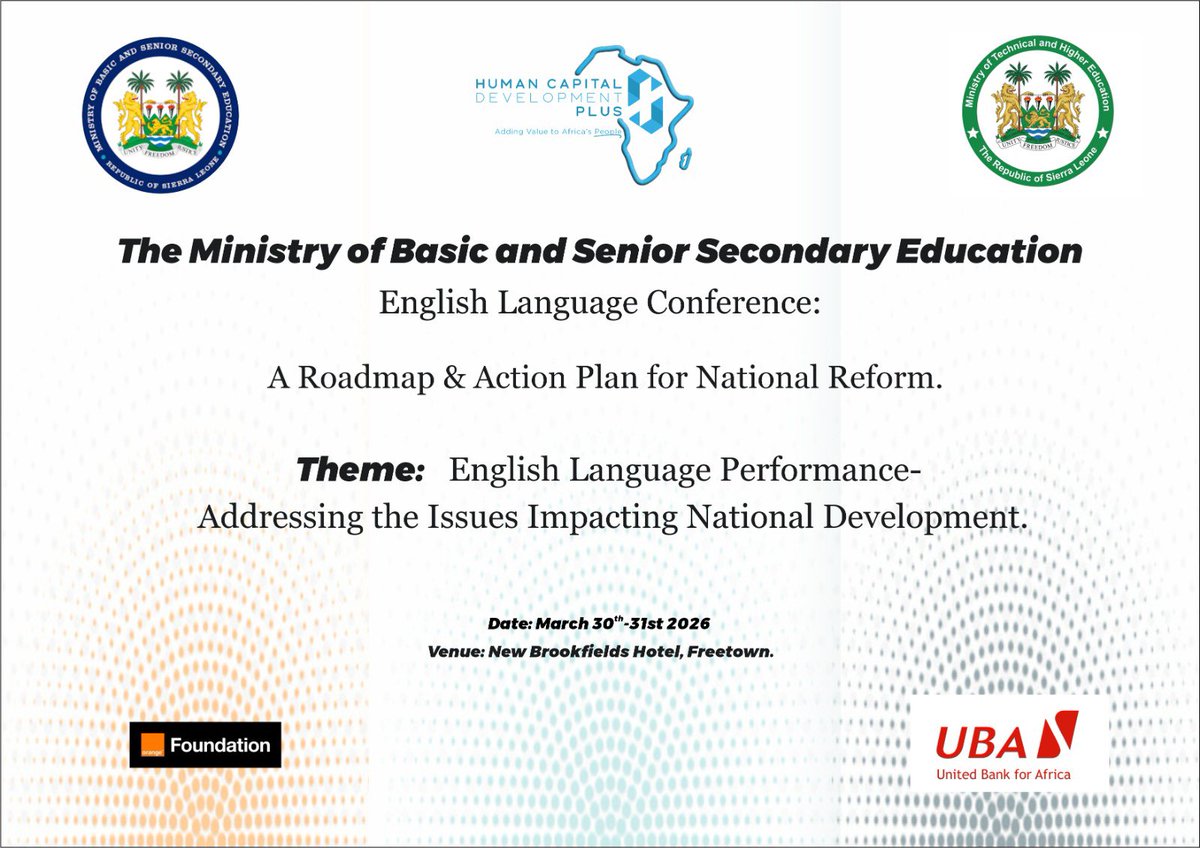
As the Ministry of Basic and Senior Secondary Education and Human Capital Development Plus gather on March 30–31, 2026 at the New Brookfields Hotel for the English Language Conference, one truth hangs heavy over the room. English is not working as the sole medium of instruction for most of our children.
The 2025 WASSCE results laid it bare. Only 11.77% of candidates passed English with credit. Sixty-three percent failed outright. Year after year, English remains the single biggest barrier to secondary-school completion, university entry, and national development. Yet we keep pretending the problem is simply “more English.” It isn’t. The deeper issue is that we are asking both students and teachers to swim in a language many of them barely understand.
It is time for a pragmatic, two-track language policy that respects evidence, protects equity, and keeps English as the high-value global skill it truly is.
For the majority of our public schools, teach in the local language first. In rural and community schools, let the medium of instruction through primary school be the dominant local language of the area. In urban and mixed areas such as Freetown, make #Krio the practical bridge language. English becomes a strong, daily, mandatory subject from Class 1 onward, taught by specialist English teachers.
This is not a retreat from #English. It is the scientifically proven way to master it. UNESCO and
World Bank studies across #Africa show that children taught in their mother tongue in the early years are far more likely to read with comprehension, master mathematics and science concepts, and later transfer those skills successfully to English. Right now, we throw most children into English-only classrooms where neither they nor their teachers are fluent. The result is exactly what we see every October: mass failure.
Many of our teachers have openly admitted they struggle to explain complex ideas in English. Using the local language as the medium would immediately empower them to teach with confidence, clarity, and creativity. Better teaching produces better learning. It is that simple.
For elite and private schools, keep English as the medium but add a national obligation. Elite schools already have the resources, the trained teachers, and the home environments that make English-medium instruction workable. They should continue. But every student in those schools must be required to study and achieve proficiency in at least one major Sierra Leonean language, Mende, Temne, Limba, Fula, Krio etc.
This is not symbolic. It is essential for national cohesion. We cannot afford a future where the children of the privileged grow up culturally disconnected from the majority of their countrymen. Requiring elite students to learn a local language turns privilege into responsibility. It signals that every educated Sierra Leonean must value our linguistic heritage. This is not radical. It is realistic.
#SierraLeone’s own 1991 Constitution and education policy already call for the teaching of national languages. In practice, however, we have never fully implemented it. Many teachers already code-switch to Krio or local languages behind closed classroom doors because they know English-only is failing their pupils. We are simply proposing to make that common-sense practice official, resourced, and scaled.
Implementation will require work the conference can begin immediately with accelerated development of teaching materials in local languages, some already exist through NGOs and can be scaled, targeted retraining for teachers so they become confident bilingual educators, a phased rollout should start with pilot districts in 2027, evaluate, then expand and Public-private partnerships, @UBA_SierraLeone and other sponsors already at the conference are natural allies.
Critics will say this lowers standards. The opposite is true. Strong foundations in a familiar language raise standards. Countries that have adopted early mother-tongue education with a strong transition to English have seen literacy rates and exam pass rates climb dramatically. Sierra Leone can do the same.
The Free Quality School Education programme has brought more children into classrooms. Now we must ensure they actually learn once they get there. A two-track language policy does exactly that. It gives every child, rich or poor, a fighting chance to succeed without sacrificing our ambition for global competitiveness.
The Ministry’s conference theme is “English Language Performance: Addressing the Issues Impacting National Development.” The conference is timely, and Minister Conrad O Sackey and the Ministry must be commended for holding it, but let us address the real issue. English is not the problem. English taught badly and too early is the problem. Pair it intelligently with our own languages, and we will finally unlock the potential of every Sierra Leonean child.
The roadmap and action plan emerging from the conference must reflect this reality. Teach our children to think first, in a language they understand. Then give them English, properly, systematically, and well. That is the roadmap Sierra Leone has been waiting for. This conference is the moment to write it.