
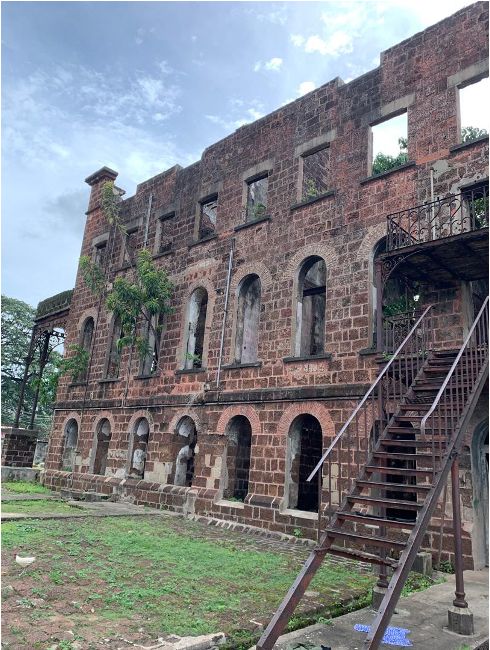
The description of Fourah Bay College (FBC) as the “Athens of West Africa” has long been repeated as a badge of honor. Yet the phrase deserves closer scrutiny, not because Fourah Bay College lacks historical importance, but because the metaphor itself carries a heavy colonial genealogy . It is not an innocent compliment. Rather, it is an invention that shaped how knowledge, prestige, and social hierarchy were imagined in colonial/post-colonial Sierra Leone and beyond. To take seriously the contemporary call to decolonize knowledge, one must begin by interrogating such inventions, asking not merely whether they are true, but what work they perform and what damage they continue to inflict.
At first glance, the comparison to Athens appears flattering. Classical Athens is conventionally portrayed as the cradle of philosophy, democracy, and rational inquiry. To call FBC the Athens of West Africa therefore suggests that it was a center of learning, refinement, and intellectual excellence. But the metaphor does more than praise; it situates African intellectual life within a hierarchy in which Europe remains the reference point. Excellence is measured by resemblance to Europe rather than by the intrinsic value of African intellectual traditions. The metaphor thus subtly Europeanizes the very idea of knowledge.
This is the first function of the Athens myth: it establishes Europe as the universal standard. The implication is not simply that FBC was a great institution, but that it was great because it approximated a European ideal. In this way, the metaphor displaces local genealogies of knowledge and replaces them with a single, prestigious lineage: Athens/Greece to Britain, Britain to Freetown/Sierra Leone. The historical reality, however, was far more complex. Long before the establishment of colonial colleges, West Africa was home to rich traditions of Islamic scholarship, jurisprudence, theology, and literature. Networks of learning connected scholars across the Sahel and the forest regions, while oral traditions preserved sophisticated systems of historical memory, ethics, and political thought. The Athens metaphor obscures these traditions by rendering them invisible or secondary.
A second function of the myth lies in the production of elite identity. The notion of the Durham breed, a formulation tagged to Harry Sawyer, often associated with FBC graduates during the colonial period, illustrates how education became tied to a particular social persona. Mastery of English, familiarity with the European canon, and adoption of certain manners or accents were taken as signs of intellectual superiority and fitness to govern. Education ceased to be merely a process of learning and became a marker of belonging to a cultivated caste. The Athens metaphor reinforced this hierarchy by suggesting that true intellect resided in those who had been initiated into the classical tradition. The Durham Breed also bred a Brahmin caste—a coterie of high caste intellectuals: Harry Sawyer; Arthur Porter; Kenneth Dike; and Eldred Jones. But Dike and Jones belong to special group—distinguished scholars who would define and shape two key disciplines in the humanities: African history and African literature in English.
This elite formation had lasting social consequences. It contributed to divisions between the educated and the so-called uneducated, between urban and rural populations, and between those who spoke the language of colonial administration and those who did not. The metaphor thus functioned as a boundary-making device, distinguishing those deemed civilized from those considered backward. Even after independence, these hierarchies did not disappear; they became internalized, shaping perceptions of authority, competence, and leadership.
A third dimension of the Athens myth concerns the narrowing of what counts as knowledge. The classical curriculum introduced in colonial institutions privileged certain texts and disciplines while marginalizing others. Greek and Latin authors were treated as the foundation of universal thought, whereas African histories, languages, and philosophical traditions were often excluded or relegated to the margins. This hierarchy of knowledge was not accidental; it reflected the needs of a colonial system that required intermediaries trained in its own intellectual framework.
To provincialise the Athens metaphor, therefore, is not to deny that students at Fourah Bay College studied classical texts or engaged in rigorous intellectual work. It is to recognize that the curriculum itself was embedded in a broader project of imperial governance. Classical education served as a disciplinary language, shaping how students understood law, politics, and civilization. By presenting European history as universal history, it naturalized the authority of empire.
Yet the persistence of the Athens myth cannot be explained solely by colonial imposition. It also reflects a psychological economy of recognition. For colonized societies, the acknowledgment of excellence by European institutions carried immense symbolic weight. To be called the Athens of West Africa was to be seen, to be validated, to be included—however conditionally—in a global narrative of progress. This desire for recognition is understandable, but it comes at a cost. It fosters a form of self-alienation in which value is derived from external approval rather than internal criteria.
The damage of this mentality is evident in the enduring sense of inadequacy that often accompanies comparisons with European standards. Institutions are judged not by how effectively they address local needs but by how closely they approximate foreign models. Intellectual life becomes oriented toward imitation rather than innovation. The Athens metaphor, in this sense, perpetuates a permanent condition of “almostness,” in which African achievements are acknowledged only insofar as they resemble European precedents.
How, then, can the Athens myth be disarmed?— or, to use Dipesh Chakrabathy’s incendiary formulation, provincialized? One strategy is to provincialize Athens itself. Classical Greece was not a timeless ideal but a particular historical society marked by its own conflicts, exclusions, and limitations. Its “democratic” institutions coexisted with slavery and gender inequality; its intellectual life was shaped by specific political and cultural conditions. To treat Athens as the universal benchmark of civilization is to ignore the contingency of its history.
Another strategy is to recover and foreground alternative genealogies of knowledge. Sierra Leone and the wider West African sub-region possess rich intellectual traditions that do not derive from Europe. These include Islamic scholarship, Atlantic anti-colonial thought, indigenous systems of law and governance, and the creative literatures and oral histories of diverse communities. By bringing these traditions into the center of academic and public discourse, one can challenge the assumption that intellectual legitimacy must be imported.
It is also important to reinterpret the history of Fourah Bay College itself. Rather than viewing it simply as a colonial transplant, one can understand it as a site of translation, negotiation, and resistance. Students and teachers did not passively absorb European ideas; they adapted, contested, and reworked them in response to local conditions. The history of FBC includes not only the transmission of colonial knowledge but also the emergence of African intellectuals who contributed to nationalist and Pan-African movements. The emergence of Dike and Jones as foundational scholars who shaped two key disciplines have already been mentioned. This more complex and conflicting narrative undermines the notion that the college’s significance lies solely in its resemblance to Athens.
Ultimately, to provincialise the invention of the Athens of West Africa is not to reject education, scholarship, or intellectual rigor. It is to question the frameworks through which these values have been defined and measured. Decolonizing knowledge requires more than adding African content to existing curricula; it requires rethinking the very metaphors that shape our understanding of intellectual life.
If Fourah Bay College is to be celebrated, it should be celebrated on its own terms: as a historic institution in West Africa, as a meeting point of diverse traditions, and as a space where new forms of thought can emerge. To move beyond the Athens myth is to affirm that intellectual excellence does not need a European mirror in order to exist. It is to recognize that the measure of knowledge must be rooted in the histories, languages, cultures, and aspirations of the societies that produce it. Only then can the lingering shadows of colonial metaphors be fully dispelled.
Ibrahim Abdullah Leicester Peak/Freetown/20/3/26.