
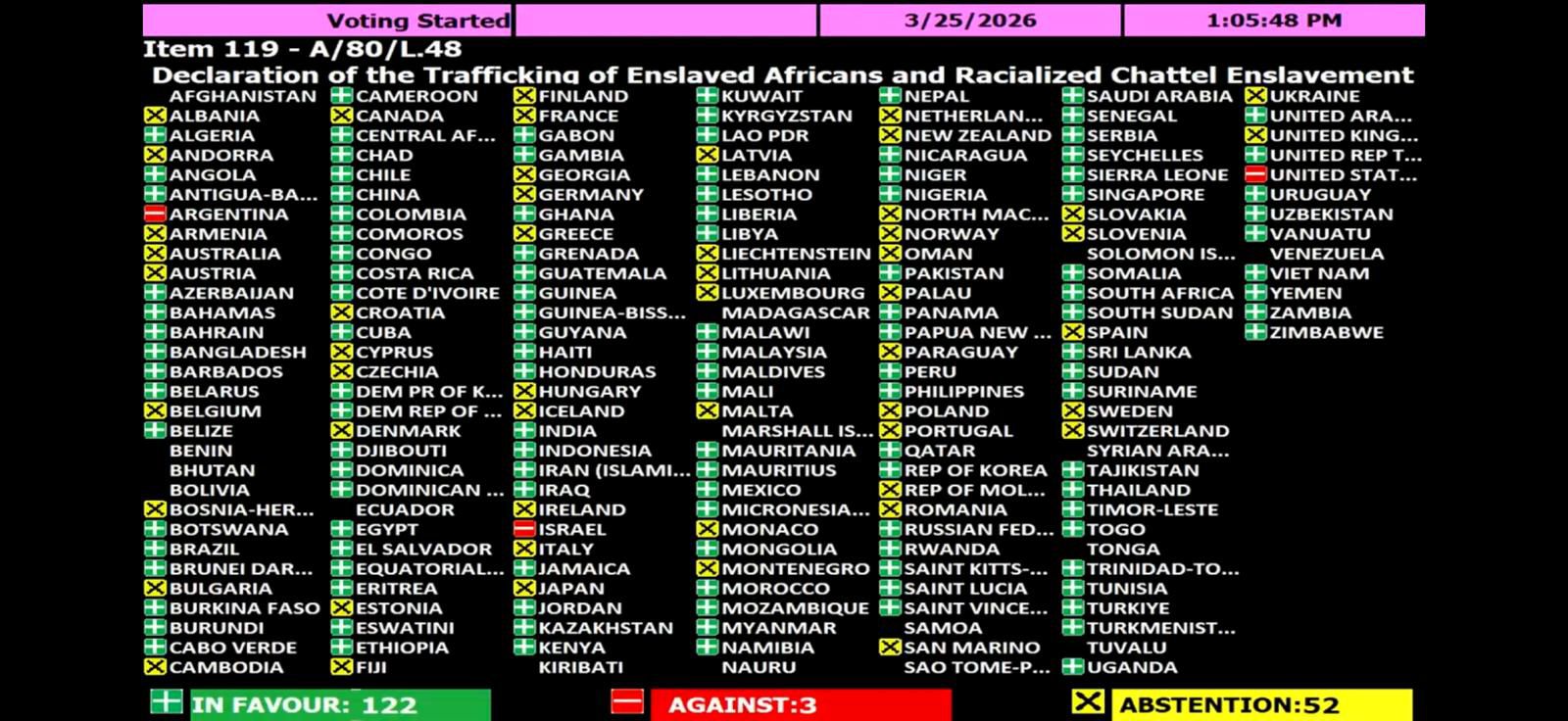
Yesterday, the United Nations General Assembly did something long overdue. By a vote of 123 in favour, 3 against and 52 abstentions, it adopted resolution A/80/L.48, formally declaring the trafficking of enslaved Africans and racialised chattel enslavement of Africans “the gravest crime against humanity.”
For Sierra Leoneans, this is not abstract history. Bunce Island, just off our coast, was one of the most notorious slave-trading fortresses in the transatlantic system. Tens of thousands of our ancestors passed through its dungeons before being shipped across the Middle Passage. Yet Freetown, the “Province of Freedom,” was founded by freed slaves and recaptives who refused to let that horror define their future. Today’s resolution feels like the global community is finally catching up with what we have always known in our bones, this was not merely a “trade.” It was a systematic, state-sponsored assault on African humanity whose consequences still structure the lives and life chances of people of African descent across the world.
We owe a profound debt of gratitude to Ghana’s President John Dramani Mahama, who led this charge on behalf of the African Group. He spoke with the moral authority of a leader who understands that reparatory justice is not charity, it is a debt long overdue. In championing this text, backed by the African Union and the Caribbean Community, he has turned decades of quiet advocacy into a resounding global affirmation. Ghana has once again shown the continent how to lead with dignity and purpose. President Mahama, Sierra Leone salutes you.
The text is far more than a symbolic gesture. It unequivocally condemns the 400-year trafficking and racialised chattel enslavement of Africans as the most inhumane and enduring injustice in recorded history. It recognises the crime as a violation of _jus cogens_, peremptory norms of international law from which no state may derogate. It explicitly links that crime to the structural racism, underdevelopment and racial inequalities that continue to afflict Africans and people of African descent across the world today. And it calls for concrete reparatory justice: full and formal apologies, restitution of cultural artefacts, compensation, rehabilitation and guarantees of non-repetition.
The resolution’s preamble is remarkable in its historical precision. It traces the legal architecture of enslavement from the papal bulls of 1452 and 1455, which authorised the reduction of Africans to “perpetual slavery,” through the Barbados Slave Code of 1661, the French _Code Noir_ of 1685, and the Virginia _partus sequitur ventrem_ principle of 1662, which made the status of property biologically inheritable through the womb of enslaved African mothers. This was, as the resolution states, the first global regime to convert human reproduction itself into a mechanism of capital accumulation. That is not ancient history. It is the foundation on which the modern global economy was built.
Critics, led by the United States, one of only three nations to vote against, argue there is no legal right to reparations for wrongs not illegal under international law at the time. But this misses the point entirely. Those legal codes did not sit on the sidelines of history. They structured the accumulation of wealth that underpins the global hierarchy that exists today. The EU, for its part, abstained rather than opposed, citing procedural technicalities and the use of the word “gravest.” That distinction is telling, unwilling to say yes, unwilling to say no, caught between moral acknowledgement and political discomfort. Abstention, in this case, is its own statement.
Yesterday’s vote did not happen in isolation. It follows a consistent pattern at the General Assembly, on the New International Economic Order in 2022, on global tax cooperation in 2023, and now on reparatory justice, in which roughly 123 to 125 nations of the Global South coalesce around a common demand for a fairer world, while the same bloc of wealthy states either opposes or steps back. The subjects differ but the logic is the same: the rules of the international order were written by those who benefited from extraction, and the Global South is increasingly unwilling to pretend otherwise.
Co-sponsoring the resolution is a beginning, not an end. Our government must now integrate the full history of the slave trade into school curricula, push actively within the AU’s 2026–2036 Decade of Action on Reparations, demand the restitution of our cultural artefacts and archives, and align our foreign policy with the broader Global South economic agenda. The three votes analysed here are not unrelated, reparations, tax justice and a new economic order are three faces of the same coin.
This is not about extracting payments for today’s politicians. It is about repairing the broken foundations of dignity and self-determination that centuries of extraction shattered, and about building an international system fit for the twenty-first century rather than one still serving the interests of the nineteenth.
President Mahama has given Africa a powerful victory on the very day the world remembers the victims of slavery. History beckoned. Africa answered. The road ahead will be long and contested, but yesterday, 123 nations spoke. And the world heard them.