
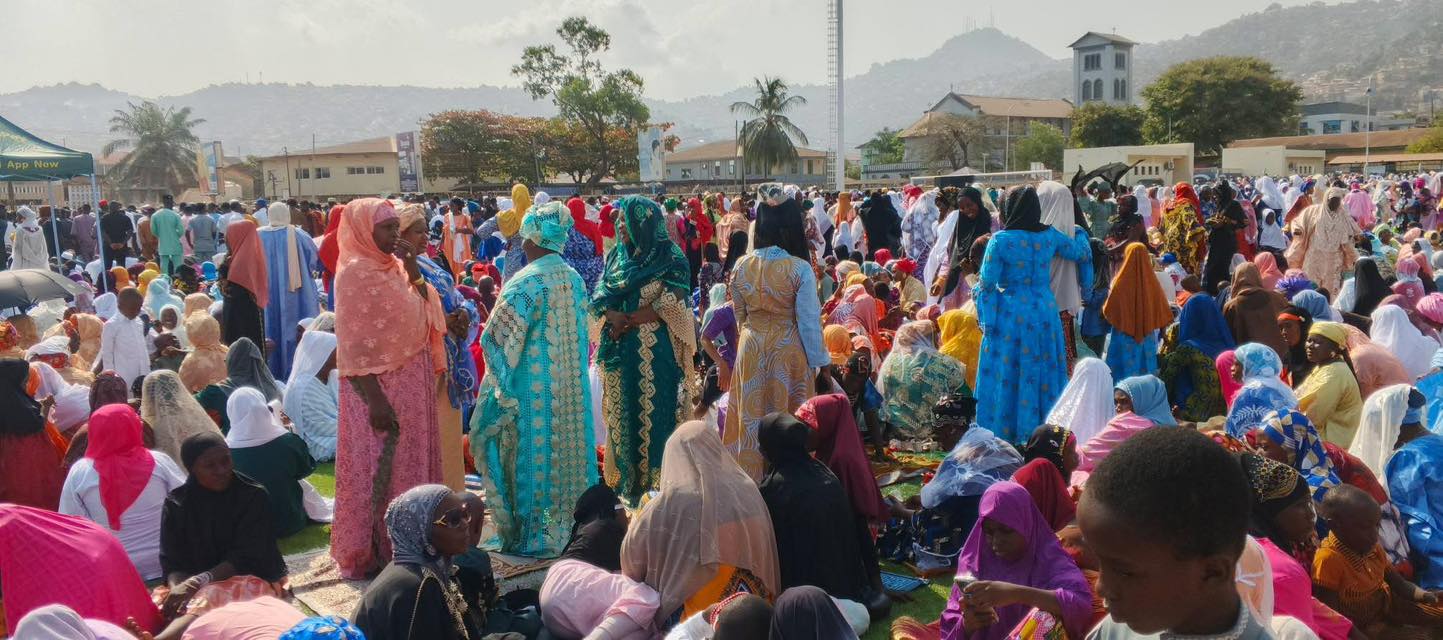
On Friday morning, as Sierra Leone marked Eid al-Fitr, I watched what I have watched every year of my life: thousands of Muslims streaming into open fields across Freetown, Bo, Kenema and Makeni, laying their prayer mats on dusty ground beneath a furious March sun. They came to pray. They stayed for hours to hear the imam deliver the khutbah. Children fidgeted in new clothes already damp with sweat. Elderly men and women sat motionless, enduring. Nobody complained. That is the culture. That is the faith.
But the faith was never meant to be a death sentence. And the sun that beat down on Friday’s worshippers was not the sun our grandparents knew.
The thermometer in Freetown touched 31°C. The UV index hit 14, classified by the World Health Organisation as “extreme,” a level at which unprotected skin can burn in under ten minutes. Humidity hovered between 60 and 80 per cent, turning the air into something you do not so much breathe as chew. And across the country, tens of thousands of people, the very young, the very old, pregnant women, the chronically ill, stood, sat and knelt in it for the better part of the morning.
This is not an argument against outdoor prayer. The Sunnah encourages it. But it is an urgent argument for adaptation, because Sierra Leone is getting hotter, fast. According to an IMF climate diagnostic published in 2024, temperatures have climbed by 1.32°C since the 1950–1980 baseline, with extreme hot days rising sharply since the 1980s. Under current emissions trajectories, warming could reach an additional 1.3°C to 3.0°C by century’s end, and the number of days above 35°C in the north and west could more than double by 2050. Freetown’s chief heat officer, Eugenia Kargbo, the first such official anywhere in Africa, has tracked roughly a four-degree rise in peak summer temperatures in barely half a decade.
The danger is not hypothetical. In April 2024, a catastrophic heatwave swept West Africa. West Africa Democracy Radio reported that in the Malian city of Kayes, the mercury reached 48.5°C; a single hospital in Bamako recorded 102 deaths in four days. The World Weather Attribution network concluded the event would not have been possible without human-caused climate change. Sierra Leone is not the Sahel, but its combination of coastal humidity and rising baseline temperatures makes heat stress here uniquely punishing, the body simply cannot cool itself when the air is both hot and saturated with moisture.
Yet every Eid, we carry on as though the climate of 2026 were the climate of 1986. No shade. No water stations. No staggered timing. We simply endure and call it devotion. Islam demands precisely the opposite. The Qur’an appoints human beings as khalifah, stewards of the earth. The Prophet, peace be upon him, taught that “your body has a right over you.” The principle of la darar wa la dirar means no harm shall be inflicted or reciprocated. This is a bedrock of Islamic jurisprudence. There is nothing pious about exposing the vulnerable to preventable suffering.
The solutions are neither exotic nor expensive. Large canopy tents over the main prayer grounds would preserve the communal atmosphere while shielding worshippers from ultraviolet assault. The Prophet’s Mosque in Medina has done exactly this with retractable umbrella canopies. Sierra Leone need not replicate that engineering, but local materials, treated canvas, corrugated panels, bamboo-and-tarpaulin, are already used in our markets. Where outdoor shade is impractical, we should do what we already do when the rains come and move indoors.
But the problem extends far beyond the prayer ground. Sierra Leone is a football-mad nation where matches routinely kick off at midday. Players, referees and spectators bake. There is no reason fixtures cannot shift to late afternoon, as leagues across the Middle East and southern Europe have done for years. Traffic police officers in dark uniforms stand at unshaded junctions for hours with no canopies, no rotation schedules calibrated to the heat index, no rehydration salts. A 2024 research review in the International Journal of Biometeorology confirmed that outdoor workers in tropical Africa face severe adverse effects on wellbeing, cognition and safety from prolonged heat exposure. Our officers live that finding every day.
Freetown’s markets are overwhelmingly open-air, with women selling fish and cassava from dawn until dusk with nothing overhead but a headscarf; the city’s pioneering Heat Action Plan has begun installing canopies in 15 of 42 markets, but it must become a standard, not a pilot. And okada riders, the arteries of our transport system, spend entire days exposed to the elements, many without helmets, a helmetless head under a UV index of 14 is a direct pathway to heatstroke.
The common thread is plain. The people most exposed to extreme heat in Sierra Leone are also the poorest. This is a climate-justice issue as much as a public-health one. The WHO estimates that around 489,000 heat-related deaths occur globally each year, with the true toll in sub-Saharan Africa almost certainly undercounted.
Freetown, to its credit, has been ahead of most African cities. Mayor Yvonne Aki-Sawyerr’s appointment of Kargbo was genuinely pioneering, and the city’s Heat Action Plan targeting 60 per cent heat-awareness by 2030, with urban cooling corridors and tree-planting campaigns, provides a framework other Sierra Leonean cities should adopt. But frameworks are only as good as the funding behind them, and the national conversation about heat remains woefully narrow, focused on Freetown while the provinces quietly swelter.
What is needed is a national heat-adaptation strategy. The Supreme Islamic Council should convene with the Ministries of Health and Environment to agree on shade standards for prayer grounds and guidance on khutbah timing during peak heat months. The Football Association should mandate late evening kick-offs from February to April. The Police should implement shaded traffic booths and proper rotation schedules. Local councils should make market shade a budget line item, not a donor-funded afterthought. And helmet laws that already exist on paper should be enforced, with subsidised provision.
None of this requires revolutionary expenditure. What it requires is the recognition that the climate in which our institutions and customs were designed no longer exists. March in Sierra Leone has always been hot. But “always been hot” is not the same as “hot enough to kill.”
On Friday, after the prayers and the feasting, I drove through Freetown and saw okada riders bare-headed in the glare, traders wilting behind their stalls, police officers rigid as statues at junctions where the tarmac shimmered. All of them doing what they have always done — simply because they have always done it.
Our faith teaches us that God does not change the condition of a people until they change what is in themselves. The sun is changing. It is long past time we changed with it.