
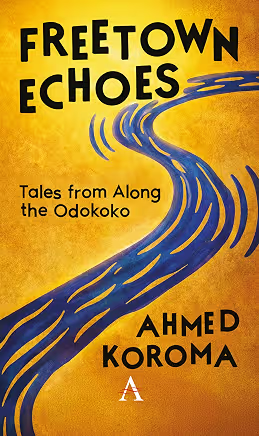
Freetown Echoes: Tales from Along the Odokoko
Ahmed Koroma. Anthem Press, London. 142 pages.
Reviewed by Abdul Tejan-Cole
I chuckled my way through this book. Ahmed Koroma, better known to those of us who grew up with him as Stokes, has written about the Freetown in the 1970s, and he has written about my childhood as much as his own. We are contemporaries. I did Form One to Form Five at the Prince of Wales School and then crossed to neighbouring St Edward’s at Kingtom. Stokes took the opposite path. Both of us ended up using the back routes of “canal” to attend Fourah Bay College, bumping into each other most evenings as we climbed the steps of Lati Hyde.
Odokoko runs from the hills of Mount Aureol down through Bambara Spring to Susan’s Bay. For most of the world, the name means nothing. For those of us from the East End of Freetown, the name means everything, and no writer has done more to make the Odokoko known beyond Freetown. Stokes came to prose by way of poetry. His debut collection, Of Flour and Tears, came first, then Along the Odokoko River, then The Moon Rises Over Isale Eko, for which I had the privilege of writing the foreword.
All three return again and again to the central and east end of the city, and the subtitle of this new book echoes the title of the second collection. The poet shows on every page of the prose. The stream is “sometimes wild, sometimes weary, but never still.” Dusk paints the riverbanks “in soft molten gold.” A drunk old man in Victoria Park sways “like a weary child.” You hear the ear of a man who has spent years weighing every line.
The book holds 24 stories following a boy, Stokes, and his four friends, Osman, Unisa, Ali and Salieu, from the infant nursery classroom in 1971 to secondary school in 1978. This brought to mind Enid Blyton’s Famous Five. Anyone who was a child in Freetown then will feel the jolt of recognition. The red ribbons Miss Coker ties on the children’s wrists on the Monday in March 1971 when the country switched from left to right-hand traffic. The Sierra Leone Library, where a stern lady librarian forgives Stoke’s fines and lets him borrow again. Byblos cinema and the scramble at the gate for the first matinee of Sholay. Garrincha’s one-bedroom home, packed with neighbours watching then Zaire (now DRC) lose nine goals to nil at the 1974 World Cup. Congolese rumba from every radio. Bournvita is a treat rare enough to steal. Stokes remembers what we ate, what we sang and what we feared.
The heart of the book lies in how faith worked along the creek and Freetown then. The opening story spends Good Friday morning beating an effigy of Judas through the streets and the afternoon at Jummah prayers on Mountain Cut. Nobody sees a contradiction. In “Aladura” and “Mothers of Salem” the boys slip into two churches, get thrown out of one and prayed over in the other. In “A Christmas Carol” three Muslim boys give themselves Krio names and village origin, Stokes calls himself Josephus Cole of Hastings, Osman becomes William Thorpe of Gloucester village, and Salieu becomes Emmanuel Coker of Kissy. Unisa needs no disguise, since Aunty Teresa already knows him as Claudius Thomas. Aunty Teresa sees through the trick and rewards them anyway. This was the Freetown I knew. We shared each other’s holidays and each other’s food, and Stokes captures the ease of it without once preaching.
He gives equal respect to older powers. Eku Mason, the healer who “owns the poison and the antidote,” heads the egungun of the Ojeh society. A “moriman” drives a jinn out of a young girl. The mermaid Marie Odokoko calls to a wild boy from beneath the bridge. Osman, the group’s sceptic and trickster, scoffs at all of it until an exorcism leaves him doubting his own doubts. Osman carries much of the book’s humour, and every East End of Freetown reader will know a boy like him.
The stories also tell a record worth keeping. Legendary bands such as Sabanoh 75 and Afro National, social clubs such as Ambas Geda and Boys London, the church hall playhouse where Elephant commands the stage with a wooden gun. Two stories show women chiefs settling disputes at the court barre, one ordering compensation and treatment in place of punishment for a man plainly unwell. As a lawyer, I read these scenes as a portrait of customary justice at work long before any statute caught up. The later stories let national history in. The republic proclaimed at Victoria Park in April 1971, the violence of the 1973 election, the Fourah Bay College protest of January 1977. Politics arrives as the boys grew old enough to notice.
The book has faults. The prose sometimes loves description too much, and a few stories would gain from a lighter hand. The text uses American spelling throughout, illustrating the Americanization of this Freetown-born author with a London publisher. Readers outside Sierra Leone will also want a glossary. Words such as iledi, moriman and court barre pass without explanation in the early stories, though later ones handle local terms with more care.
None of this dims its immense achievement. Stokes remains the best ambassador Odokoko has ever had, and this book is his fullest tribute to the place. He dedicates the book to Claudius Unisa Thomas, “whose candle dimmed in those early years,” and Unisa walks through the stories as the quiet friend who warns the others against every escapade and joins them anyway. The final page sends Stokes home past the Cotton Tree and Victoria Park, “closer to the person I was quietly becoming.” Reading those words, I felt the same. Stokes has given the boys of Odokoko and the East End of Freetown their book. If you are from there, you will laugh and you will remember. If you are not, you will finish knowing why he never stops talking about Odokoko.