By Hon. Ibrahim Barrie
Opposition APC Member of Parliament representing Bombali District
Lecturer, University of Makeni
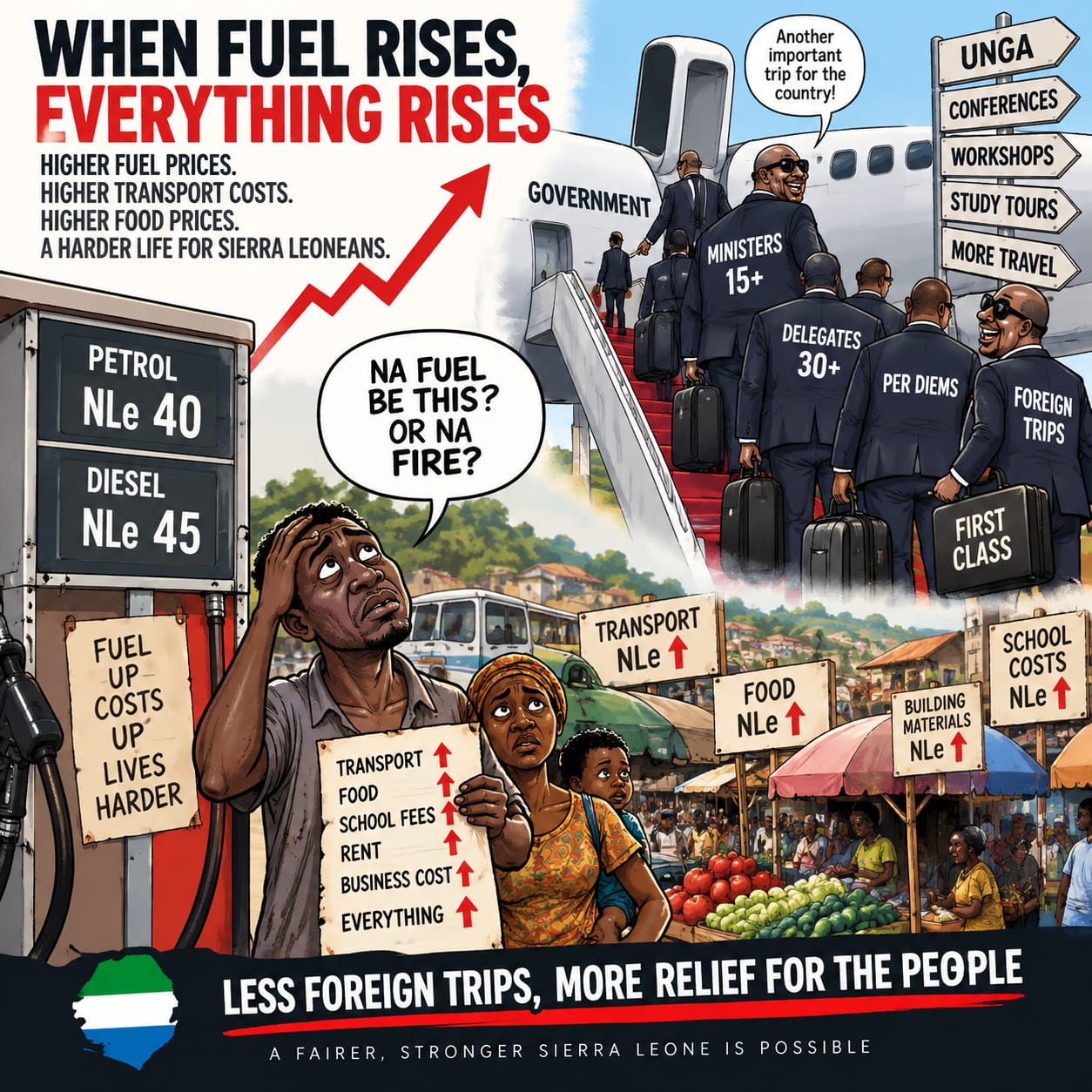
Sierra Leoneans are once again facing a difficult economic reality. As fuel prices rise, the consequences are being felt far beyond the filling station. When fuel rises, transport rises; when transport rises, the cost of moving food and goods rises; and ultimately, the ordinary household pays the price.
The present situation therefore demands more than a discussion about the price of petrol and diesel. It requires a serious national conversation about the cost of living, government expenditure and how we protect ordinary Sierra Leoneans from economic shocks.
At a time when families are struggling with the rising cost of transportation and basic necessities, government must also look critically at its own expenditure. This includes official travel, large delegations, accommodation, per diems, conferences, workshops, vehicle purchases and other administrative expenditures.
The question is not whether government officials should travel when travel is necessary. The question is whether every major expenditure represents the highest priority at a time when citizens are under increasing economic pressure.
A government that asks citizens to tighten their belts must also examine its own belt.
There are lessons Sierra Leone can draw from other countries, including Ghana, where government has undertaken expenditure-rationalisation measures while also considering interventions to cushion citizens from economic pressures.
However, expenditure cuts must be carefully considered. Essential social services such as education, healthcare, school feeding and social protection should not automatically become the first casualties of fiscal adjustment. Any reprioritisation should be based on transparent assessment of what is essential, what can be postponed and where genuine savings can be achieved without disproportionately hurting vulnerable citizens.
At the same time, government should consider targeted and temporary measures to cushion consumers from exceptional fuel-price shocks, while making the fiscal cost transparent to Parliament and the public.
The longer-term response must also include improving public transportation, strengthening domestic food production, reducing dependence on imported energy, improving social protection and building greater resilience against international commodity-price shocks.
This is ultimately about a simple economic reality:
> When the price of fuel rises sharply, the impact does not stop at the pump. It travels through the entire economy and eventually reaches the household.
The Government therefore has an important responsibility to balance fiscal discipline with social protection.
President Bio and his Government have an opportunity to demonstrate that discipline by examining every major area of public expenditure while simultaneously considering measures that can protect households and businesses from the immediate effects of rising fuel prices.
Sierra Leone needs an approach that protects both the stability of the national budget and the welfare of the ordinary citizen.
We must ask ourselves:
What can government reduce? What can government reprioritise? What can government temporarily subsidise? And, most importantly, how do we ensure that the burden of economic adjustment does not fall disproportionately on those who can least afford it?
This is not simply about petrol and diesel.
It is about the cost of living.
It is about the cost of doing business.
It is about food security.
It is about transportation.
It is about household welfare.
And ultimately, it is about the economic resilience of Sierra Leone.
Hon. Ibrahim Barrie
Opposition APC Member of Parliament, Bombali District
Lecturer, University of Makeni