
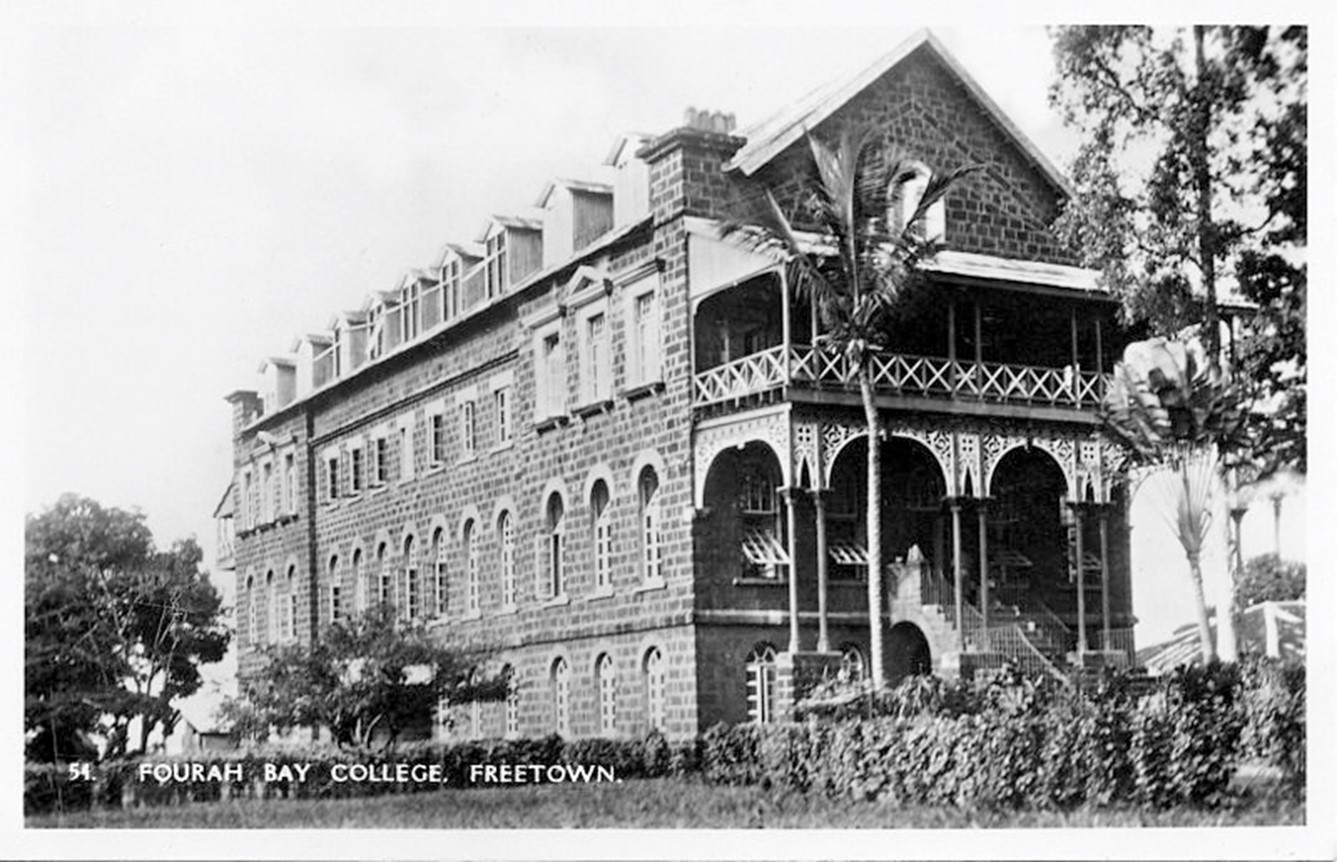
To write an intellectual history of Fourah Bay College is to begin with a paradox. The institution that could be called, with a certain colonial flourish and local pride, the Athens of West Africa was also the institution whose precedence did not become postwar dominance. Fourah Bay was first; it was venerable; it educated clergymen, civil servants, teachers, linguists, historians, economists, literary critics, theologians, and political men across West Africa. Yet by the 1950s and 1960s, when the modern African university was being made into one of the symbols of decolonization, the glamour of academic centrality moved elsewhere. Legon in Ghana, Ibadan in Nigeria, and Makerere in Uganda came to look like the go-to schools: places with expanding faculties, major research institutes, confident national projects, graduate training, publication circuits, and a new relationship between state power and scholarly ambition. Fourah Bay retained memory, seniority, and symbolic value; the others acquired momentum.
That is the question the essay must keep alive. Not whether Fourah Bay College mattered, for it plainly did, but why its historical primacy did not translate into institutional command during the decisive decade after Sierra Leone’s independence. The answer cannot be that Fourah Bay lacked scholars. It had them, and in some cases it had them in exactly the disciplines by which African universities were remaking the humanities and social sciences: Arthur Porter in history and African studies; Michael Crowder at the Institute of African Studies; N. A. W. Cox-George in economics; Harry Sawyerr in religion and philosophy; Eldred Jones in English and African literature; David Dalby and A. K. Turay in language studies; and a penumbra of teachers, editors, librarians, seminar convenors, and researchers who made Freetown a serious intellectual site. The puzzle is that these figures appear less as the nucleus of an expanding university system than as flashes of brilliance within a college whose institutional structure, funding base, scale, and political backing lagged behind the new centres.
A useful point of departure, therefore, is not a list of great names but the older form of knowledge out of which Fourah Bay emerged. Its first prestige was not that of a modern research university. It was the prestige of missionary-humanist formation: scripture, classics, English, moral philosophy, rhetoric, translation, and the training of an African clergy and clerisy. Founded in 1827 by the Church Missionary Society, and later bound to Durham through the affiliation that ran from 1876 to 1967, Fourah Bay was not born as a state university in the twentieth-century developmental sense. It was an ecclesiastical and Atlantic institution before it was a national one. Its intellectual life was formed by the demands of Christian education, translation, colonial administration, and the making of a West African educated elite. That origin was not a weakness in itself; indeed, it accounts for much of the college’s extraordinary reach. But it also meant that when the age of African national universities arrived, Fourah Bay had to be converted from an older prestige economy into a new institutional machine.
Language is the best doorway into that older world. The story around Samuel Ajayi Crowther and the missionary scholars is not antiquarian. It is the foundation of a West African scholarly practice in which language became the field where theology, ethnology, pedagogy, politics, and African agency met. Crowther’s life connects the liberated African world of Sierra Leone to Yoruba Christianization, Niger missions, and the first great experiments in African-language writing under Protestant auspices. Around him and after him came grammars, vocabularies, Bible translations, catechisms, sermons, orthographic arguments, and philological speculation. The old missionary archive was never merely missionary. It contained African intellectual labor: the work of interpreters, catechists, teachers, informants, clerics, printers, and students whose names are sometimes faint in the record but whose linguistic expertise made the enterprise possible. Fourah Bay’s early intellectual history should be read as a history of translation under unequal conditions. The African languages were made textual, but they were also made governable; they became vehicles of Christian modernity, but also resources for African self-description.
This is why the later language journals matter. The Sierra Leone Language Review, begun at Fourah Bay in the early 1960s, and later continued as the African Language Review, was not simply a technical linguistic publication. It was the return, in more modern disciplinary form, of a question that had haunted the college since Crowther: how does Africa enter the archive in its own languages? David Dalby, A. K. Turay, Eldred Jones, and their colleagues worked in a field in which the study of Mende, Temne, Krio, Fula, Mel languages, and wider West African language problems still bore the trace of missionary philology, but now with the apparatus of linguistics, African studies, and university publication. The fact that the journal migrated outward – through London publication and association with overseas Africanist networks – is itself part of the story. Freetown could generate the scholarly impulse, but the distribution system, printing capital, prestige economy, and academic market often lay elsewhere. That small displacement tells us much about the predicament of Fourah Bay after independence.
The same tension runs through religion and philosophy. Harry Alphonso Ebun Sawyerr belongs to the deeper history of Fourah Bay because he embodies both continuity and transformation. He was formed inside the Anglican and Durham-Fourah Bay world, but his intellectual work moved beyond imitation of European theology. Sawyerr’s concern with Mende belief, African religious concepts, the relation between ancestor and creator, and the possibility of Christian encounter in African categories made him one of the most important Sierra Leonean voices in the emerging field of African theology and comparative religion. In him the missionary college did not disappear; it argued with itself. He treated African religion not as the superstition to be overcome by Christian schooling, but as a philosophical and spiritual world with its own grammar. The Sierra Leone Bulletin of Religion, and Sawyerr’s association with broader journals of African religion, therefore mark an inward renovation of the old theological curriculum. Fourah Bay’s inherited Christian seriousness became, in Sawyerr’s hands, an inquiry into the African conditions of meaning.
Yet even here one sees the central difficulty. A scholar like Sawyerr could give Fourah Bay intellectual stature; he could not by himself make it Legon. Ghana under Nkrumah invested symbolic and political energy in African studies as part of a state project of cultural decolonization. The Institute of African Studies at the University of Ghana was established in 1961 as a multidisciplinary institute with an explicit mandate to research Africa in the arts and social sciences. That meant that Legon was not merely hosting scholars; it was staging a national drama about the recovery of African personality, Pan-African thought, and the reorientation of knowledge after empire. Whatever the tensions and contradictions of Nkrumah’s cultural politics, the university had state theatre behind it. Fourah Bay, by contrast, had prestige without equivalent national scale. Sierra Leone’s independence did not generate a university-building project of the same continental theatricality. The college remained precious, but not central to a revolutionary imagination of state, culture, and development in the way Legon briefly became.
Economics reveals another aspect of the problem. N. A. W. Cox-George should not be treated as a decorative disciplinary addition. His work on finance and development in West Africa placed Sierra Leone within the wider question of how colonial economies entered independence with fragile fiscal structures, unequal markets, and inherited dependency. Economics at Fourah Bay could have become a major site for thinking about mining, diamonds, shipping, customs, monetary policy, rural development, public finance, and the relation between Freetown and the Protectorate. Cox-George’s intellectual importance lies partly in the fact that he asked economic questions from a Sierra Leonean and West African vantage. But here again the institutional comparison is instructive. Nigeria’s size, resources, federal politics, and urgent need for manpower gave Ibadan a different field of possibility. The Ashby Commission and the national debate over higher education in Nigeria treated the university as a mechanism of state development. The University of Ibadan, founded in 1948 as University College Ibadan and independent by 1962, became a place where economics, history, sociology, medicine, and agriculture were linked to the production of a national elite on a vast scale. Sierra Leone needed such thinking no less urgently, but it lacked the demographic, fiscal, and political weight that made university expansion feel unavoidable in Nigeria.
Arthur Porter stands near the centre of the historical imagination that Fourah Bay could sustain. His Creoledom, published in 1963, was not a mere local history. It was an argument about the formation of Freetown society: settler, recaptive, Christian, classed, Atlantic, African, and colonial. Porter made the Creoles into an object of sociological and historical interpretation at precisely the moment when the old Creole centrality in Sierra Leonean public life was becoming more complicated in the politics of independence. His work is indispensable because Fourah Bay itself was part of the social world he studied. The college had long been tied to the formation of a Creole intelligentsia, but the postcolonial state had to negotiate a broader national constituency in which the Protectorate, indigenous languages, rural histories, and non-creole political energies demanded recognition. In that sense, Fourah Bay’s early brilliance became ambiguous. It represented West African cosmopolitanism, but it also represented an older Freetown-based elite formation whose authority could no longer be assumed in the age of mass politics.
This is one reason Ibadan’s ascent was so striking. Kenneth Onwuka Dike, himself an alumnus of Fourah Bay, helped create at Ibadan the historical school that Fourah Bay might have been expected to dominate. Dike’s Institute of African Studies at Ibadan, founded in 1962, and his work in archives, oral tradition, and Nigerian historiography showed how a university could turn the writing of African history into a nation-making enterprise. There is a certain irony here: Fourah Bay helped train men who then built the disciplines elsewhere. Its diaspora was one of its achievements and one of its losses. The college radiated talent across West Africa, but by the 1950s and 1960s, the larger states and newer universities were better placed to absorb, fund, and institutionalize that talent. The old Athens exported its sons; Ibadan and Legon built departments around them.
Michael Crowder’s years at the Institute of African Studies sharpen this point. Crowder was director at Fourah Bay in the mid-1960s and wrote about the Institute as an interdisciplinary body with teaching functions, concentrating on social and economic problems on the one hand, and culture and history on the other. This was exactly the right design. It recognized that African studies could not be confined to folklore or antiquity; it had to include development, economy, social change, political transformation, and historical memory. The Africana Research Bulletin, published by the Institute, should therefore be read as a record of a possible university: a modest but serious infrastructure for research on Sierra Leone and West Africa. Its pages and bibliographic traces suggest field reports, local studies, census and demographic material, historical fragments, political notes, cultural documentation, and the practical work of building a research community. But the modesty matters. Compared with Ibadan’s historical school, Legon’s state-backed Pan-African cultural project, or Makerere’s long-established East African research networks, Fourah Bay’s Institute looked vulnerable, underfunded, and dependent on a changing cast of expatriate and Sierra Leonean scholars.
Makerere’s case is especially revealing because it too was older than the postwar decolonizing moment, yet it converted older regional functions into modern university authority more successfully than Fourah Bay. Makerere became a university college in special relationship with London in 1949; by the 1960s it was part of the University of East Africa, serving Uganda, Kenya, and Tanganyika/Tanzania in a regional arrangement. Its Institute of Social Research, established in 1948 as the East African Institute of Social Research, gave it an early research base in anthropology, economics, sociology, and political studies. Makerere also occupied a regional educational geography: it could draw students from across East Africa and was tied to medicine, agriculture, social research, and the administrative needs of several territories. Fourah Bay had once performed a comparable West African regional role, but by the mid-twentieth century the region had changed. Nigeria and Ghana no longer needed Freetown as their principal advanced educational gateway. They had their own colleges, their own nationalist elites, and their own claims to intellectual centrality.
Eldred Jones and African Literature Today demonstrate both the persistence of Fourah Bay’s brilliance and the limits of its institutional capture. Jones made Freetown one of the important points in the emergence of African literature as a field of criticism. African Literature Today, begun in 1968 with Jones as founding editor, gave form to the new readership created by Chinua Achebe, Wole Soyinka, Ngugi wa Thiong’o, Gabriel Okara, Flora Nwapa, Ama Ata Aidoo, Kofi Awoonor, and the African Writers Series. Jones’s work moved English studies away from colonial reverence for the metropolitan canon and toward African writing as a subject with its own critical demands. But again the history is double. African Literature Today was born from Fourah Bay, yet its survival and circulation depended on transnational publishing networks, especially London-based ones. Freetown could provide editorial authority and intellectual taste; London provided distribution, capital, and the global academic market. This was not failure, exactly. It was the structure of postcolonial knowledge. But it meant that Fourah Bay’s intellectual achievements often became visible through institutions located elsewhere.
The journals, then, are not appendices. They are the small machines through which one can hear the ambition and the constraint of the college. Africana Research Bulletin shows the Institute of African Studies attempting to gather Sierra Leone and West Africa into a researchable field. Sierra Leone Bulletin of Religion and the broader journal networks around African religion show theology becoming religious studies and African philosophy. Sierra Leone Language Review and African Language Review show the old philological vocation becoming modern linguistics and African language study. African Literature Today shows English becoming African literature. Fourah Bay Studies in Language and Literature, later associated with the English Department, belongs to this same family of projects. Together these periodicals tell a story of disciplinary conversion: mission into linguistics; theology into African religion; English into African literature; colonial ethnography into African studies; local history into social science. They also tell a story of migration. The journals often had to seek durability abroad. Their routes of publication and distribution passed through London, Indiana, SOAS, Frank Cass, Heinemann, and other overseas networks. The intellectual centre was not always the printing centre. The editorial origin was not always the market centre.
To say this is not to diminish Fourah Bay. It is to free it from a sentimental vocabulary that has sometimes trapped it. The phrase Athens of West Africa is powerful, but it is also misleading. Athens suggests origin, refinement, and classical seniority; it does not explain laboratories, libraries, state budgets, postgraduate fellowships, journals, presses, housing, salaries, or research leave. By 1960, the African university was becoming an institution of development planning and national prestige. It needed not only learned women/men but recurrent funding; not only tradition but expansion; not only a college memory but faculties, institutes, professional schools, and graduate pipelines. Fourah Bay had symbolic capital, but Legon, Ibadan, and Makerere increasingly had institutional capital. Their rise was not simply meritocratic. It was produced by state policy, colonial and postcolonial commissions, metropolitan university arrangements, national demography, and regional geopolitics.
The chronology matters. Fourah Bay’s Durham affiliation, for all its prestige, tied the college to a particular older model of external validation. Its students could earn degrees under a British system, but the arrangement also reflected dependency. By the time it ended in 1967, the new African university world had already moved rapidly. Legon had been founded in 1948, became the University of Ghana in 1961, and had an Institute of African Studies framed by Nkrumah’s continental ambitions. Ibadan began in 1948, became independent in 1962, and under Kenneth Dike became a centre of African historical scholarship. Makerere had a London relationship from 1949, became central to the University of East Africa in 1963, and drew upon a research infrastructure that predated independence. Fourah Bay, although older than all of them, was in some respects late to the modern race. Its Institute of African Studies was established in 1964, its ambitious research plans were articulated in the mid-1960s, and the University of Sierra Leone structure arrived in 1967 with the amalgamation of Fourah Bay and Njala. In other words, FBC entered the postcolonial university decade not as the uncontested senior institution, but as a venerable college trying to modernize while its rivals were already scaling up.
The first decade of independence, from 1961 to 1970, should therefore be read not as a simple decline but as a missed conversion. Sierra Leone did experience optimism; Njala was founded in the early 1960s; educational development mattered; minerals promised revenue; and Freetown retained a cosmopolitan intellectual life. But the college did not become the West African powerhouse its past might have foretold. Part of the reason lay in scale. Sierra Leone’s population, tax base, and administrative reach were smaller than Nigeria’s or Ghana’s. Part lay in political economy. Diamonds and minerals generated revenue but also distorted politics and development priorities. Part lay in inherited social geography: the old Freetown elite, the Protectorate, and the postcolonial party system did not produce a single, sustained university project comparable to Nkrumah’s Legon or Nigeria’s Ashby-era expansion. Part lay in academic infrastructure: libraries, presses, fellowships, housing, and research funds were insufficient to hold all the talent the college could attract or produce. Part lay in the timing of decolonization: FBC had been early in the nineteenth century, but it was not early in the twentieth-century institutionalization of African research universities.
There is also a question of disciplinary confidence. Fourah Bay’s early curriculum gave it a superb humanist inheritance, but the postwar African university demanded new combinations: economics with development planning, history with national archives, language studies with field linguistics, literature with publishing, anthropology with social research, agriculture with rural modernization, medicine with public health, engineering with infrastructure. Makerere had medicine and regional social research; Ibadan built archives, history, medicine, and social sciences inside a giant national field; Legon joined humanities to a presidential cultural project. Fourah Bay had parts of this mosaic, but not always the institutional density that could make the parts mutually reinforcing. The great names sometimes stood like pillars without enough building around them.
This is why a serious intellectual history of Fourah Bay should avoid both nostalgia and indictment. The college did not simply fail; it carried an older burden. It had to be missionary seminary, colonial college, West African training ground, Sierra Leonean national university, and African studies centre in succession, and sometimes all at once. Its symbolic inheritance was both a resource and a weight. It had to honor Crowther while creating Dalby; it had to preserve theology while making room for Sawyerr’s African religious thought; it had to teach English while allowing Eldred Jones to make African literature central; it had to train civil servants while Cox-George asked harder questions about finance and development; it had to remember Creoledom while Porter historicized it; it had to welcome Crowder while cultivating Sierra Leonean leadership in research. That is not a thin history. It is a crowded one, full of conversions that were never fully consolidated.
Perhaps the final argument is that Fourah Bay’s intellectual history is best understood as a history of firstness without institutional succession. It was first in the sense that it opened a path; it was not first in the later sense of commanding the research university order of independent Africa. Its intellectual contributions often moved outward: to Nigerian historiography through alumni like Dike, to African literature through Jones’s editorial networks, to African linguistics through journals that migrated, to African theology through Sawyerr’s wider ecumenical influence, to Sierra Leonean social history through Porter, and to interdisciplinary African studies through Crowder’s Institute. The college’s influence was therefore diasporic, editorial, clerical, pedagogical, and symbolic as much as institutional. Legon, Ibadan, and Makerere became the go-to schools because they converted postwar opportunity into state-backed institutional density. Fourah Bay remained a fountainhead, but not the main reservoir.
That difference should shape the tone of the essay. Fourah Bay should be written neither as a fallen Athens nor as an overrated relic. It should be written as a college whose nineteenth-century achievement was so great that it obscured the twentieth-century question: how does inherited prestige become modern capacity? Its scholars answered parts of that question magnificently. Crowther and the philologists made language a field of African intellectual labor; Sawyerr made religion and philosophy answerable to African categories; Cox-George made economics speak to West African development; Porter historicized the society that had produced the college’s elite; Crowder tried to give African studies institutional form; Eldred Jones made African literature a world discipline from Freetown. But institutions are not made by brilliance alone. They are made by money, politics, publishing, demography, buildings, graduate students, libraries, and state imagination. In the decade after independence Fourah Bay had enough brilliance to remain unforgettable, but not enough institutional force to remain unavoidable. That is the undercurrent: the Athens survived as memory, while the modern African university moved to places where memory could be joined to machinery.
Ibrahim Abdullah 10/6/26