
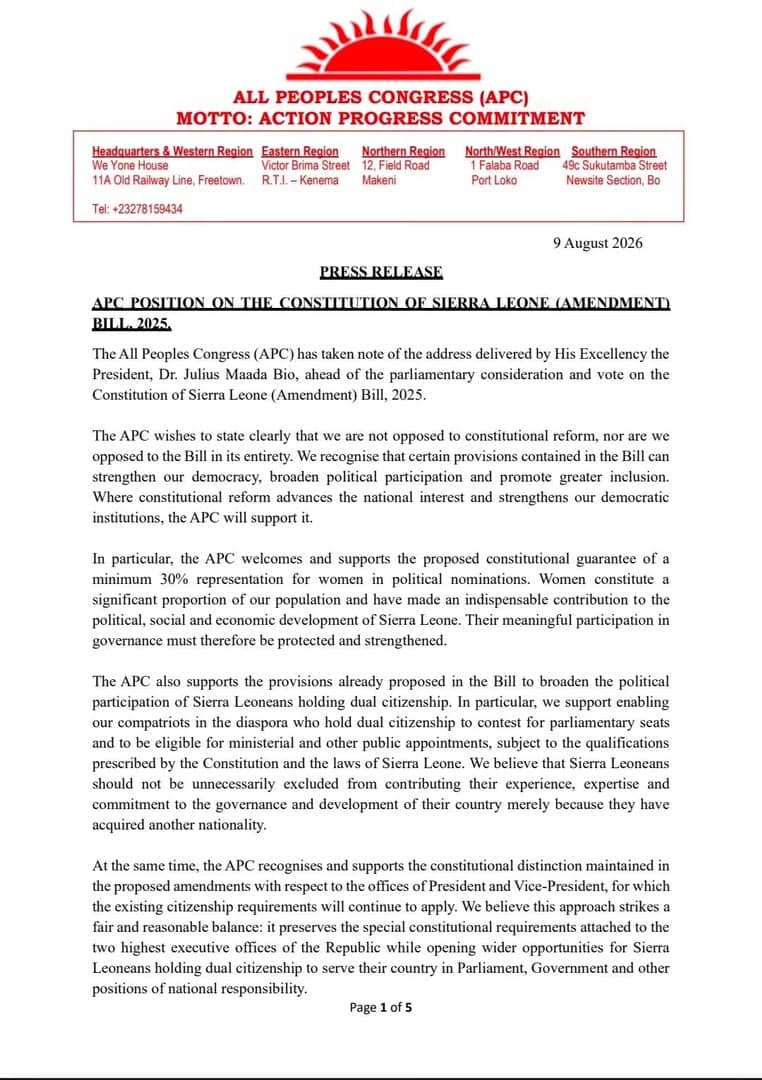
The All People’s Congress (APC) has outlined its position on the proposed Constitution of Sierra Leone (Amendment) Bill, 2025, backing several reforms aimed at broadening political participation while opposing measures it believes could significantly alter the country’s electoral framework.
In a statement issued on 9 August 2026, the opposition party said it supports constitutional reform in principle and does not reject the amendment bill outright. Instead, APC argued that reforms should be assessed individually based on their ability to strengthen democracy, promote inclusion, and advance the national interest.
Notably, the party welcomed the proposal guaranteeing a minimum 30 percent representation for women in political nominations, describing women’s participation in governance as essential to Sierra Leone’s political, social, and economic progress.
APC also expressed support for provisions expanding opportunities for Sierra Leoneans holding dual citizenship to contest parliamentary elections and qualify for ministerial and other public appointments, subject to constitutional and legal requirements. The party maintained that citizens living abroad should not be excluded from contributing their expertise and experience to national development simply because they possess another nationality.
Meanwhile, APC endorsed retaining existing citizenship requirements for the offices of President and Vice-President, arguing that the proposed arrangement balances broader political participation with constitutional safeguards attached to the country’s highest executive offices.
Despite this support for several reforms, the party strongly opposed any move away from the First-Past-the-Post (FPTP) constituency-based electoral system. APC argued that constituency representation preserves a direct and accountable relationship between elected representatives and the communities they serve.
Moreover, the party maintained that support for FPTP extends beyond partisan considerations and reflects views expressed during constitutional consultations by traditional leaders, civil society organisations, religious bodies, and ordinary citizens.
The statement further defended retention of the 55 percent presidential threshold, arguing that the requirement encourages candidates to build support across regional, ethnic, and political divides while promoting coalition-building and national consensus.
In APC’s view, Sierra Leone’s diversity requires constitutional arrangements that encourage broad national appeal rather than narrow political mobilisation.
Against this backdrop, the party called on Members of Parliament to approach the forthcoming vote as a matter of national importance rather than partisan competition. APC stressed that while governments and political majorities may change, the Constitution remains the supreme law governing all citizens.
Ultimately, the party’s position reflects a nuanced approach to constitutional reform—supporting measures related to women’s representation and diaspora participation while resisting proposed changes to the electoral system and presidential election threshold.
As parliamentary debate continues, APC’s intervention adds another significant perspective to a constitutional conversation that is increasingly shaping Sierra Leone’s democratic future.