
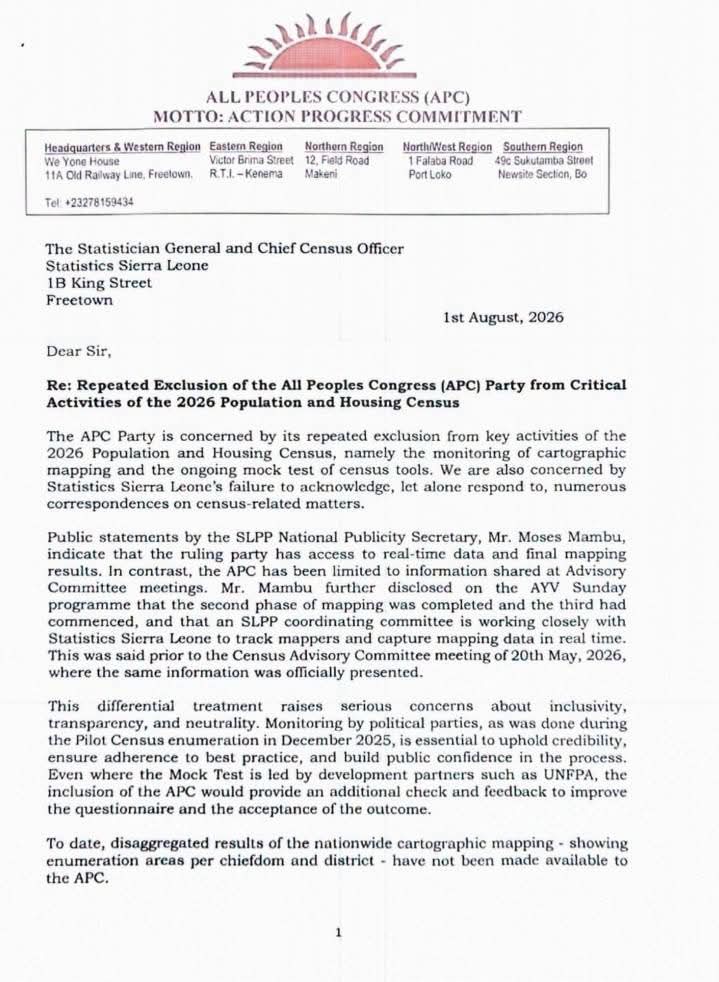
The All People’s Congress (APC) has formally written to Statistics Sierra Leone, expressing concern over what it describes as repeated exclusion from key activities linked to the ongoing 2026 Population and Housing Census.
In a letter dated 1 August 2026 and signed by National Secretary General Lansana Dumbuya, the opposition party questioned transparency and inclusiveness within the census process, arguing that it has been denied access to critical census-related information and monitoring activities.
According to the letter, concerns stem from alleged exclusion from monitoring cartographic mapping exercises as well as ongoing mock tests of census tools. The party also accused Statistics Sierra Leone of failing to acknowledge or respond to several correspondences relating to census matters.
It further cited public statements made by SLPP National Publicity Secretary Moses Mambu, which it claims suggested that the ruling party had access to real-time mapping data and final mapping results. While SLPP appeared to possess detailed information on census activities, opposition officials argued that they had been limited to updates shared during Census Advisory Committee meetings.
Consequently, party officials maintained that this situation raises concerns about neutrality, transparency, and equal participation in a process expected to serve national interests rather than partisan objectives.
According to the correspondence, participation by political parties in census monitoring is important because it strengthens public confidence, promotes adherence to best practices, and enhances the credibility of census outcomes. The opposition noted that similar monitoring arrangements were permitted during Pilot Census Enumeration conducted in December 2025 and therefore argued that comparable access should be granted throughout the current exercise.
The party also complained that disaggregated results from nationwide cartographic mapping, including enumeration areas by district and chiefdom, have not been made available.
To safeguard what it described as credibility and nationwide acceptance of the census, it called on Statistics Sierra Leone to:
Grant equal access to both major political parties to monitor census activities;
Publish detailed cartographic mapping results; and
Strictly adhere to international standards and professional best practices.
Additionally, the opposition demanded publication of three key documents and datasets:
Results of Pilot Census Cartographic Mapping conducted between June and July 2025;
Findings from Pilot Census Enumeration undertaken in December 2025; and
Completed nationwide cartographic mapping data, including enumeration areas by district and chiefdom, sections by chiefdom, and localities by section.
Despite these concerns, party officials reiterated their commitment to supporting Government and Statistics Sierra Leone in conducting what they described as a credible, transparent, and constitutionally compliant Population and Housing Census.
Copies of the letter were also sent to several national and international stakeholders, including Ministry of Planning and Economic Development, UNFPA, World Bank, United Nations Resident Coordinator’s Office, UNDP, UNICEF, European Union, United States Embassy, British High Commission, African Development Bank, African Union Commission, ECOWAS, and UK Foreign, Commonwealth and Development Office.
Meanwhile, this development adds a new dimension to ongoing discussions surrounding the 2026 Population and Housing Census, as increasing attention continues to focus on transparency, stakeholder participation, and public confidence in one of Sierra Leone’s most significant national statistical exercises.