By Edward Dictionary Caulker
Every State Opening of Parliament serves two important purposes. First, it allows Government to account for its stewardship. Second, it provides citizens with a benchmark against which future performance can be measured.
This year’s address followed that tradition.
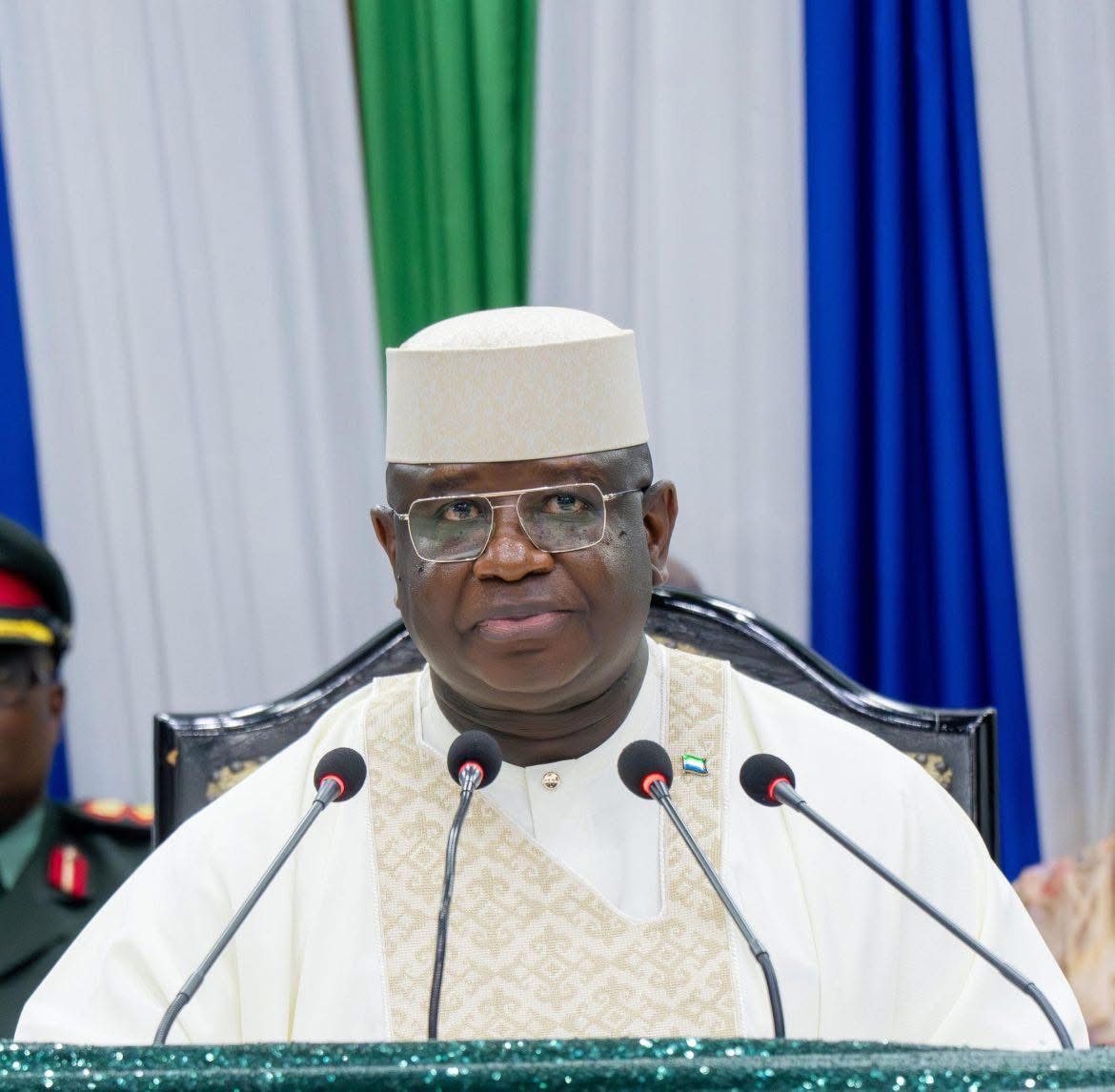
President Julius Maada Bio devoted a significant portion of his 2026 State Opening Address to economic performance, presenting a picture of macroeconomic recovery, fiscal discipline, and improving financial stability. Yet beyond the statistics lies a more important consideration: are these gains translating into meaningful improvements in the daily lives of ordinary Sierra Leoneans?
That remains the central question in any balanced assessment of the President’s economic narrative.
To appreciate the argument presented by Government, it is necessary to understand the context within which those claims were made.
The President reminded Parliament that Sierra Leone continues to operate in an uncertain global environment. Conflicts in Ukraine and the Middle East have disrupted supply chains while increasing the cost of food, fuel, fertiliser, and transportation across international markets.
For an economy that remains heavily dependent on imports, such external shocks inevitably influence domestic prices, household spending, and overall economic stability.
Against this backdrop, Government maintains that its responsibility has been twofold: protecting citizens from external economic pressures while simultaneously building a more resilient economy capable of withstanding future crises.
Viewed from this perspective, the administration argues that its performance should be assessed not against ideal conditions but against the realities of a difficult global economic climate.
The strongest element of the President’s presentation was undoubtedly the statistical evidence used to support claims of recovery.
According to the address, real GDP growth increased from 4.6 percent in 2024 to 4.8 percent in 2025. Inflation fell sharply to 4.4 percent by December 2025 after remaining in double digits for an extended period. Although inflation later rose to 10.8 percent in April 2026, Government attributed that increase largely to renewed pressure from global oil prices.
Other indicators also pointed in a positive direction. Exchange-rate depreciation remained below one percent during 2025, Treasury bill rates declined from 41.2 percent to 17 percent, while private-sector lending reportedly expanded by 50 percent.
Meanwhile, domestic revenue increased from NLe14.6 billion to NLe18 billion. The trade deficit narrowed from USD1.60 billion to USD1.07 billion, fiscal deficit levels improved from 5.4 percent to 4.4 percent of GDP, and public debt fell from 50.8 percent to 49.3 percent of GDP.
Taken together, these indicators portray an economy that has become more stable at the macroeconomic level.
For investors, development partners, economists, and financial institutions, such trends often signal improving fiscal management and stronger economic fundamentals.
Government also relied heavily on Sierra Leone’s relationship with international financial institutions as evidence that economic reforms are producing results.
The President highlighted continued progress under the International Monetary Fund’s Extended Credit Facility programme, noting that approximately USD79.8 million was released in December 2025, followed by a further USD31.7 million in June 2026.
In addition, Sierra Leone secured approval for USD211.45 million under the IMF’s Resilience and Sustainability Facility.
These developments carry significance because multilateral institutions typically require countries to meet strict economic benchmarks before additional resources are approved. Consequently, Government views these approvals as external confirmation that its economic management strategy remains on track.
Development Financing and External Partnerships
A similar argument was made regarding development cooperation.
According to the address, Sierra Leone signed twelve new agreements with development partners in 2025, valued at approximately USD374.9 million. Actual disbursements reached USD254.4 million, including USD191.2 million in grants and USD63.2 million in loans.
Government maintains that these resources are supporting critical investments in roads, energy, water supply, healthcare, agriculture, and technology.
Such commitments indicate that international partners continue to view Sierra Leone as a country worthy of financial support despite prevailing global uncertainties.
Where the Debate Truly Begins
Yet this is precisely where the debate becomes more complex.
Macroeconomic improvement does not automatically translate into economic relief at the household level.
Interestingly, the President himself acknowledged this reality earlier in the address when he referenced mothers worried about household expenses, farmers seeking access to markets, graduates searching for employment, patients waiting for healthcare, and citizens demanding efficient public services.
Those examples highlight an important distinction.
While economists may focus on inflation trends, debt ratios, or fiscal balances, most citizens judge economic performance through everyday experience.
For many households, the real questions remain straightforward:
Can food be purchased more easily than before?
Are incomes keeping pace with rising costs?
Are jobs becoming available?
Is electricity becoming more reliable?
Are public services improving?
These concerns shape public perception far more than technical economic indicators.
The Delivery Challenge
This reality makes one statement in the President’s address particularly significant.
He declared that the Fourth Session begins in a “Year of Action and Accelerated Delivery.”
That phrase carries both promise and expectation.
On one hand, it signals an intention to move beyond policy commitments toward tangible outcomes. On the other hand, it raises the standard by which Government will now be judged.
Citizens increasingly expect results that can be seen, felt, and measured in everyday life.
Consequently, the challenge facing Government is no longer simply maintaining macroeconomic stability. The greater task is ensuring that stability produces visible improvements in living standards.
Economic growth matters when it creates jobs.
Fiscal discipline matters when it improves public services.
Investment agreements matter when projects are completed and communities benefit from them.
Without that connection, statistical progress risks remaining disconnected from public experience.
A fair assessment of the President’s economic presentation leads to two important conclusions.
First, Government has presented credible evidence of improvement across several major economic indicators. Inflation trends, fiscal balances, domestic revenue mobilisation, debt management, private-sector lending, and international financing all point toward greater macroeconomic stability.
Second, those achievements do not automatically resolve concerns about affordability, employment opportunities, public service delivery, or household welfare.
Both realities can coexist.
An economy can improve statistically while citizens continue to experience financial hardship. Equally, temporary hardship does not necessarily invalidate genuine progress occurring at the macroeconomic level.
Recognising both realities is essential for an honest evaluation of economic performance.
President Bio’s 2026 State Opening Address offered one of the most data-driven economic presentations of his second term. It sought to demonstrate that Sierra Leone’s economy is becoming more stable, disciplined, and resilient despite significant external pressures.
However, economic success will ultimately be judged not only by growth rates, IMF reviews, or fiscal reports, but by the experiences of ordinary Sierra Leoneans.
The figures presented before Parliament provide grounds for cautious optimism. Nevertheless, optimism alone will not be enough. Those numbers must eventually translate into lower living costs, stronger businesses, more employment opportunities, improved public services, and greater economic security for citizens.
Ultimately, economic recovery is not defined solely by what Government can report.
It is defined by what people can feel.
That remains the most important test of the President’s economic narrative.