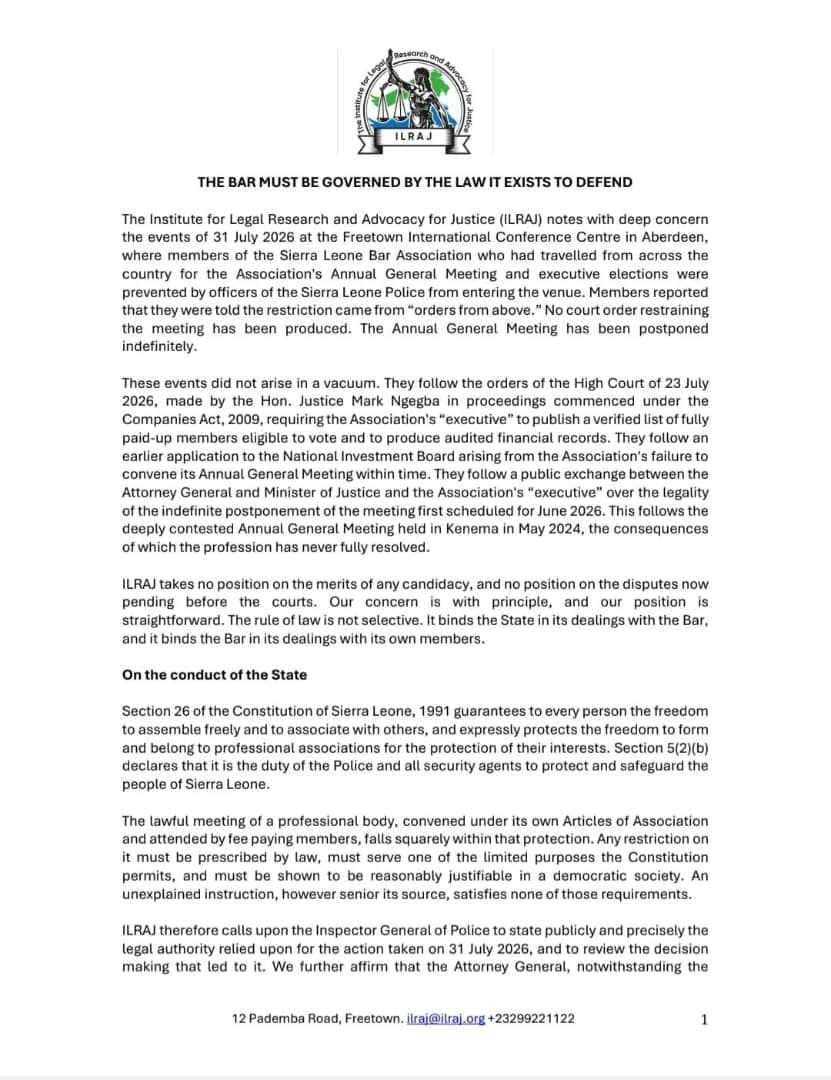
The Institute for Legal Research and Advocacy for Justice (ILRAJ) has issued a strongly worded position paper on events surrounding the 31 July 2026 Annual General Meeting (AGM) of the Sierra Leone Bar Association (SLBA), urging both State authorities and the legal profession to uphold the rule of law and protect the independence of the Bar.
ILRAJ expressed concern after members of the Bar Association, who had travelled from across Sierra Leone to attend the AGM and executive elections at the Freetown International Conference Centre, were prevented from entering the venue by police officers. According to the institute, members were reportedly informed that the restriction came from “orders from above.” However, no court order authorising such action has been made public. Consequently, proceedings were postponed indefinitely.
Although critical of the police intervention, ILRAJ maintained that the dispute did not begin on 31 July. Instead, it traced the current impasse to a series of unresolved governance issues within the Bar Association, including a High Court order issued on 23 July 2026 directing the Association’s Executive to publish a verified register of fully paid-up members eligible to vote and to produce audited financial records. The institute also referenced earlier disputes relating to delays in holding the AGM and concerns arising from the contested May 2024 elections.
Regarding the role of the State, ILRAJ argued that Sierra Leone’s Constitution guarantees freedom of assembly and protects professional associations from unlawful interference. Therefore, it stated that any restriction on a lawful meeting must be supported by a clear legal basis. In its view, an unexplained instruction from an unnamed authority does not satisfy that constitutional requirement.
Accordingly, the organisation called on the Inspector General of Police to publicly explain the legal authority relied upon for actions taken on 31 July and to review the decision-making process that led to the disruption. It further emphasised that concerns relating to the affairs of the Bar Association should be addressed through the courts rather than through administrative directives or police intervention.
At the same time, ILRAJ stressed that the Bar Association must also be held to the standards it expects of others. It argued that an institution committed to defending the rule of law must demonstrate transparency and full compliance with its Articles of Association, the Companies Act, 2009, and all lawful court orders.
The institute further observed that disputes surrounding the Bar’s elections have persisted since May 2024, while concerns over voter registers, election procedures, and governance arrangements remain unresolved. It noted that the Executive’s two-year mandate has now expired. As a result, individuals whose tenure has lapsed continue to exercise control over membership records, financial accounts, and the timing of elections intended to replace them. ILRAJ described this as a governance challenge requiring urgent attention.
To restore confidence in the process, ILRAJ recommended the appointment of an independent interim body to oversee the affairs of the Association. Such a body, it said, should ensure full compliance with the High Court’s directives by publishing a verified register of eligible members, presenting audited accounts dating back to May 2024, and facilitating a lawful election process.
In addition, the institute proposed that future elections be managed by an independent electoral committee agreed upon by all candidates and observed by representatives of the legal profession and civil society. It also recommended the adoption of a written electoral code to guide future elections and strengthen accountability within the Association.
ILRAJ concluded that both Government and the Bar Association have responsibilities that cannot be ignored. It warned that a Bar Association unable to manage its affairs in accordance with the law risks weakening its moral authority. Similarly, it argued that a State that determines when lawyers may assemble risks undermining one of the country’s most important institutions of accountability.
According to the institute, Sierra Leone needs a Bar Association that is independent, transparent, united, and lawfully governed, describing the issue as one that extends beyond the legal profession and touches directly on the country’s constitutional and democratic health.