
By Edward Dictionary Caulker
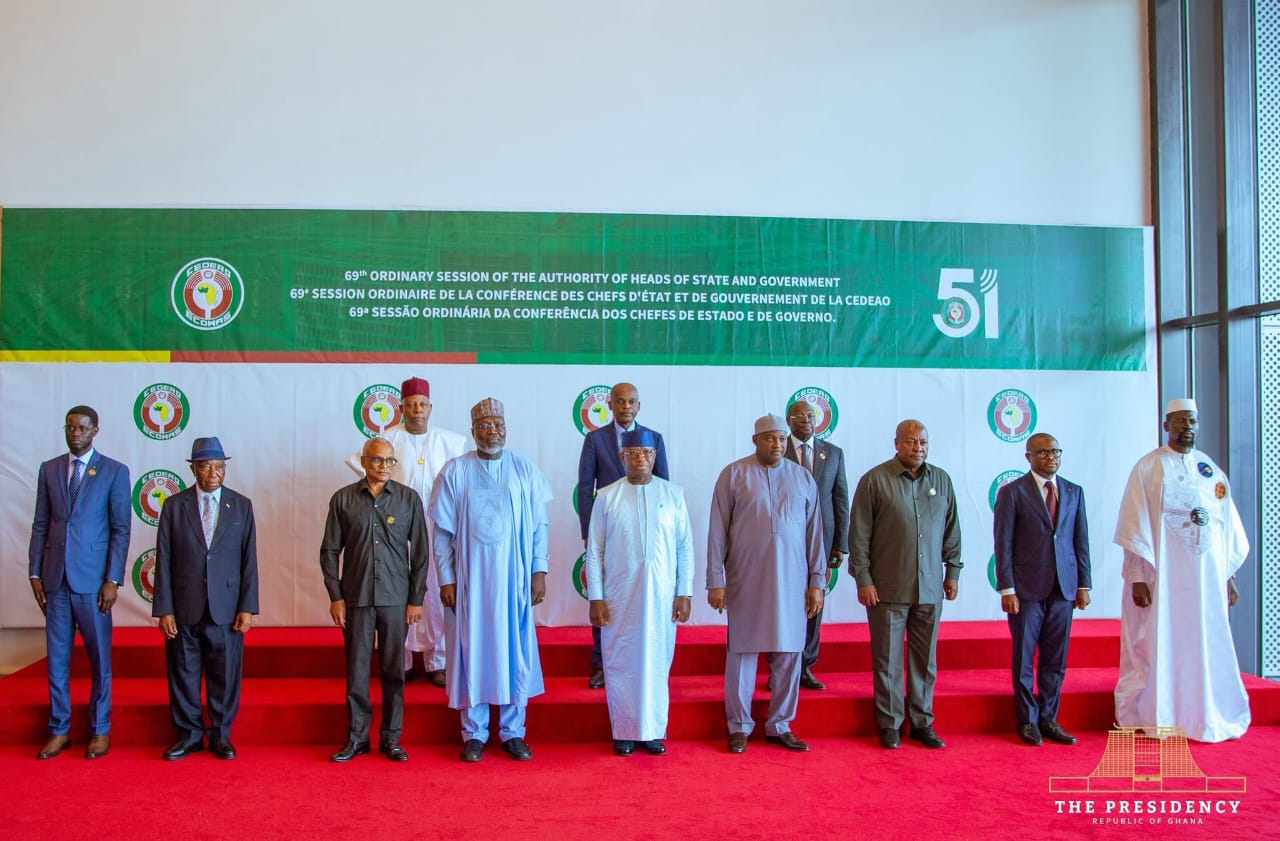
The official narrative from the 69th ECOWAS Summit in Sierra Leone is easy to summarize. President Julius Maada Bio handed over the chairmanship of the regional bloc to Senegal’s President Bassirou Diomaye Faye. New leadership was announced for the ECOWAS Commission. Leaders reaffirmed their commitment to regional integration, peace, security, and economic development.
Yet beneath the diplomatic language, ceremonial handshakes, and carefully crafted communiqués, another conversation was unfolding.
It was a conversation about frustration.
It was a conversation about expectations.
And perhaps most importantly, it was a conversation about whether ECOWAS is delivering enough tangible benefits to the people it was created to serve.
The strongest indication of this came from Guinea’s President, General Mamady Doumbouya.
His speech did not sound like that of a leader celebrating the achievements of a regional bloc. Instead, it sounded like a leader challenging the institution to confront uncomfortable realities.
Doumbouya reminded his colleagues that African unity remains essential.
“African integration is the only path to development and lasting peace. Our survival and prosperity depend on our ability to stay united.”
However, he quickly shifted from ideals to practical concerns. He argued that division weakens the region and questioned the effectiveness of punitive approaches to political disagreements.
“Division only benefits those who seek to divide us. Sanctions are not the solution, and they should be the last resort, not the first reflex.”
The statement was significant because it touched on one of ECOWAS’ most controversial tools sanctions. While the bloc has often used sanctions to defend constitutional order, critics argue that ordinary citizens frequently bear the greatest burden.
Doumbouya went further, calling on leaders to focus on development rather than endless political disputes.
“Let us refocus on the economy, investment, and well-being of our people. A strong community is one that helps its members prosper together.”
Then came the statement that may ultimately define the mood of the summit.
“Our people are waiting for roads, hospitals, energy, markets, and jobs not just words.”
In many ways, that sentence captured the growing impatience of West Africans. Across the region, citizens are less interested in declarations and more interested in outcomes. They want functioning hospitals, reliable electricity, employment opportunities, better roads, and affordable food. They want evidence that regional cooperation is improving their daily lives.
Interestingly, shortly after delivering his address, Doumbouya reportedly left the summit proceedings. Whether his departure was routine or symbolic remains unclear. Nevertheless, the optics were difficult to ignore. It left observers wondering whether his actions reflected a broader frustration with the pace and direction of regional decision-making.
If Doumbouya’s speech highlighted public frustration, President Bassirou Diomaye Faye’s address acknowledged institutional shortcomings.
As the new Chairman of ECOWAS, Faye inherited an organisation facing significant challenges, including insecurity, economic pressures, democratic tensions, and declining public confidence in regional institutions.
Rather than offering grand promises, he spoke about reform.
“Our institutions must be stronger, more efficient, and better aligned with member states.”
That statement was more than administrative language. It was an acknowledgment that ECOWAS itself must evolve if it hopes to remain relevant.
Faye also emphasized the need for urgent action on security.
“We must act quickly to address our security challenges. The Regional Force must become operational.”
At a time when terrorism, violent extremism, and political instability continue to threaten parts of West Africa, his remarks reflected growing concern that regional security mechanisms are moving too slowly.
Yet perhaps his most revealing observation was about regional integration itself.
“Regional integration must involve everyone, not remain just a declaration.”
For decades, regional integration has been one of ECOWAS’ defining ambitions. Yet many citizens still struggle to see how that vision directly affects their lives. Faye’s words suggest that the challenge is no longer designing policies; it is ensuring that people feel their impact.
Business leader Aliko Dangote approached the same concerns from an economic perspective.
While governments often celebrate growth statistics, Dangote focused on the realities behind the numbers.
“The regional economy continues to show resilience, with growth projected at about five percent this year. Yet millions of our young people remain unemployed.”
His message was straightforward. Economic growth means little if it fails to create opportunities for the region’s rapidly growing youth population.
He also highlighted another issue affecting millions across West Africa.
“Food insecurity continues to affect far too many families, while manufacturing remains limited.”
These challenges have become increasingly visible as food prices continue to rise and unemployment remains stubbornly high across many member states.
Dangote’s most powerful statement came when he reflected on ECOWAS itself.
“Fifty years is long enough for reflection, but, more importantly, it is time for renewal.”
After half a century of existence, he appeared to be asking a difficult question: Is ECOWAS evolving quickly enough to meet the demands of a changing region?
Ghana’s President John Dramani Mahama echoed similar concerns.
While reaffirming Ghana’s commitment to the core values of ECOWAS, he warned that the organisation’s future cannot depend solely on meetings and declarations.
“The future of ECOWAS cannot be built within conference rooms. There is a need for the effective implementation of all our resolutions.”
His observation strikes at the heart of one of the bloc’s longstanding challenges. ECOWAS rarely struggles to produce resolutions. The real challenge lies in implementation.
Without implementation, declarations remain aspirations rather than achievements.
Nigeria’s Vice President Kashim Shettima added another layer to the discussion.
His caution against tampering with constitutional term limits highlighted ongoing concerns about democratic governance across the region. At the same time, his remarks condemning xenophobic attacks in South Africa reflected a broader view of African solidarity.
That intervention raises an important debate. Should ECOWAS concern itself with challenges beyond West Africa’s borders, or should it focus exclusively on problems within its own community?
While opinions differ, Shettima’s remarks suggest that the future of regional cooperation may increasingly require broader continental engagement.
Liberian President Joseph Boakai perhaps brought the discussion full circle.
“The future of West Africa will not be determined by the challenges we face, but by the courage with which we respond to them.”
His statement served as both a warning and an encouragement. The challenges confronting the region are significant, but so too is the opportunity to address them through collective action.
When viewed together, the speeches delivered in Freetown reveal a common thread. Despite coming from different political systems, economic backgrounds, and national contexts, the leaders repeatedly returned to the same concerns: jobs, security, institutions, food, infrastructure, and implementation.
That is why the real story of the ECOWAS Summit may not be the transfer of leadership from President Bio to President Faye.
Nor is it the appointment of a new ECOWAS Commission President.
The real story is the growing recognition among regional leaders that West Africans are demanding results rather than rhetoric.
Citizens want roads more than resolutions.
They want jobs more than communiqués.
They want electricity more than summit declarations.
And they want institutions that work.
The speeches in Freetown suggest that many leaders understand this reality. Whether ECOWAS can translate that understanding into meaningful action remains the question that will define its next chapter.
Because what happens inside ECOWAS meetings does not stay within ECOWAS.
Eventually, it is judged in markets, classrooms, farms, businesses, hospitals, and homes across West Africa.
And that is where the true verdict on ECOWAS will always be delivered.