
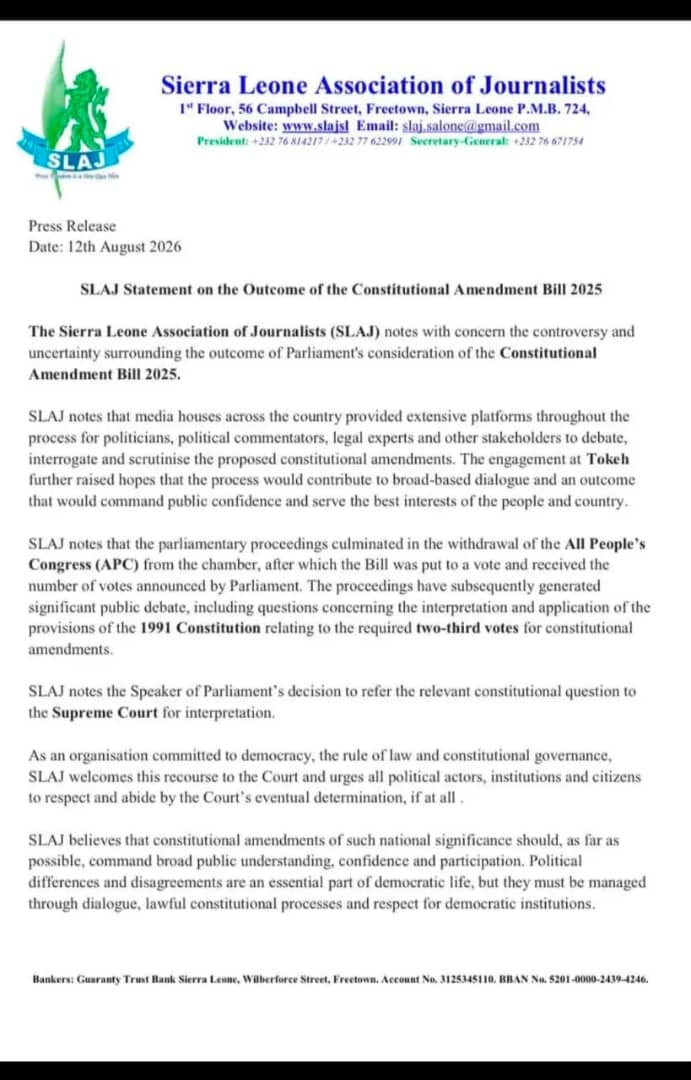
The Sierra Leone Association of Journalists (SLAJ) has welcomed the decision to refer constitutional questions arising from Parliament’s consideration of the Constitution of Sierra Leone (Amendment) Bill, 2025, to the Supreme Court while simultaneously calling on political actors, institutions, and citizens to exercise restraint as the matter proceeds through legal channels.
SLAJ expressed concern over the controversy and uncertainty that have followed Parliament’s deliberations and vote on the proposed constitutional amendments.
According to the Association, media organisations across Sierra Leone played a significant role throughout the process by providing platforms for politicians, legal experts, political commentators, civil society actors, and other stakeholders to debate, interrogate, and scrutinise proposed reforms. SLAJ noted that engagements held during the constitutional review process, including discussions in Tokeh, raised hopes that deliberations would produce broad-based dialogue and outcomes capable of commanding public confidence.
Evidently, they further observed that parliamentary proceedings culminated in the withdrawal of Members of Parliament from the All People’s Congress (APC) from the chamber, after which voting proceeded and Parliament announced the outcome. Since then, public debate has intensified around questions relating to interpretation and application of provisions within the 1991 Constitution governing requirements for constitutional amendments.
Against that backdrop, the Association welcomed Speaker of Parliament’s decision to seek guidance from the Supreme Court on issues arising from the process. SLAJ described recourse to judicial interpretation as an important constitutional mechanism capable of providing clarity and helping to strengthen public confidence in democratic institutions.
As an organisation committed to democracy, constitutional governance, and rule of law, SLAJ urged all political actors, institutions, and citizens to respect and abide by whatever determination emerges from the Court.
The Association also stressed that constitutional amendments carrying such national significance should command broad public understanding, participation, and confidence wherever possible. While acknowledging that political disagreements remain a normal feature of democratic life, SLAJ maintained that those differences must be managed through dialogue, lawful constitutional procedures, and respect for democratic institutions.
Moreover, SLAJ called on political parties and stakeholders to refrain from actions or rhetoric that could heighten tensions or weaken public trust in constitutional governance.
The Association commended media houses and journalists for extensive coverage of parliamentary proceedings, noting that sustained reporting helped citizens remain informed throughout debates, deliberations, and voting processes.
According to SLAJ, coverage provided by media organisations once again demonstrated the indispensable role of a free, independent, and professional press in promoting transparency, accountability, and informed public participation in democratic governance. The Association therefore encouraged journalists to continue providing accurate, balanced, and contextual reporting as constitutional questions move through appropriate legal and democratic processes.
Furthermore, SLAJ urged political leaders to place national interest above partisan considerations while preserving peace, tolerance, and national cohesion.
In remarks contained in the statement, SLAJ President Alhaji Manika Kamara emphasised that constitutional reform should not be reduced to a political contest between winners and losers. Instead, he argued that reforms must strengthen institutions, rights, and democratic principles upon which every Sierra Leonean depends today and for generations to come.
They concluded by reiterating that Sierra Leone’s constitutional democracy belongs to all citizens and that every reform process must ultimately serve the interests of the people and the nation.