
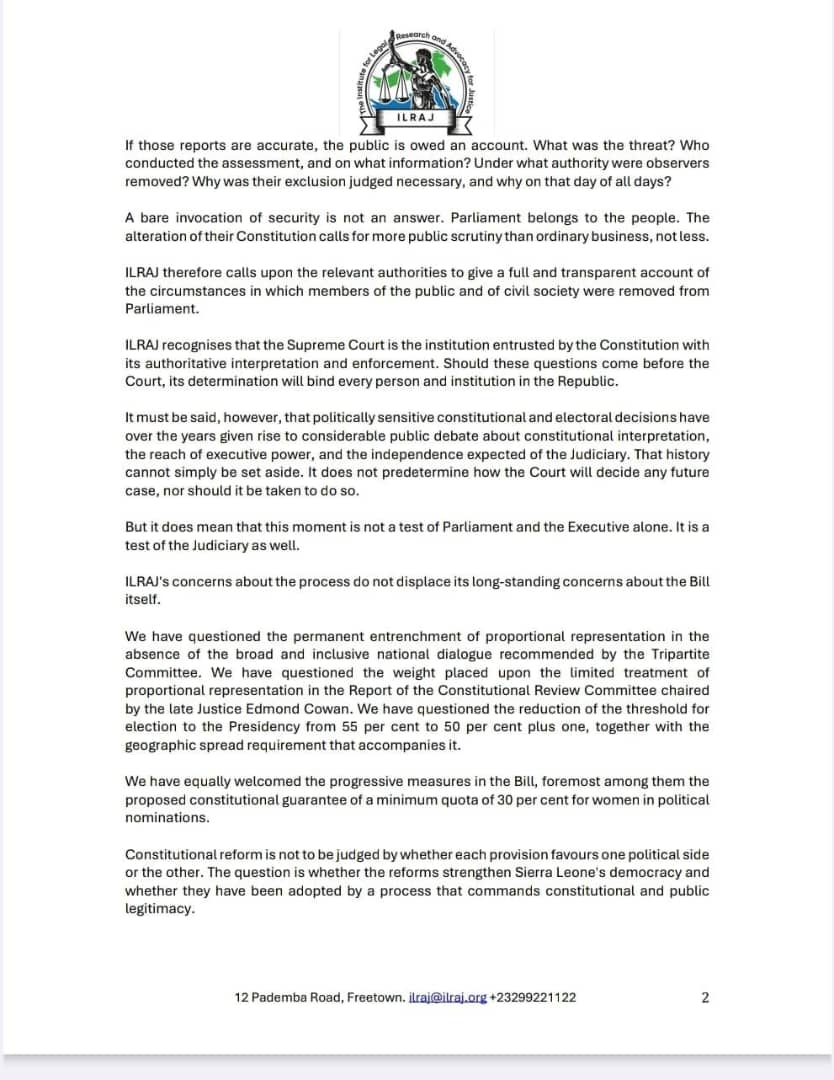
The Institute for Legal Research and Advocacy for Justice (ILRAJ) has raised serious constitutional and procedural concerns over Parliament’s reported passage of the Constitution of Sierra Leone (Amendment) Bill, 2025, on 10 August 2026.
In a three-page press statement, ILRAJ said it was “gravely concerned” about the circumstances surrounding passage of the Bill, particularly the interpretation of Section 108(2)(b) of the 1991 Constitution , which requires a Bill seeking to alter the Constitution to receive the support of not less than two-thirds of Members of Parliament at both its Second and Third Readings.
ILRAJ argues that the language of Section 108(2)(b) is clear and does not depend on the subject matter of a Bill. It also maintains that the constitutional requirement cannot be displaced by the ordinary majority rule governing routine parliamentary business.
The legal research and advocacy organisation says it is particularly troubled that the Bill was declared passed based on a different interpretation of the required voting threshold.
ILRAJ argues that the issue becomes more serious because the interpretation came from the Speaker of Parliament , who occupies a position of significant constitutional responsibility.
According to ILRAJ, if there was genuine uncertainty over the required threshold and that uncertainty was serious enough to require interpretation by the Supreme Court, clarification should have been obtained before Parliament proceeded to pass the Bill.
Instead, the organisation says the Speaker declared the Bill passed and subsequently referred the question of the threshold to the Supreme Court.
ILRAJ describes this sequence as creating a “constitutional fait accompli”, with the courts potentially being asked to determine the legality of a process only after Parliament had acted.
“A safeguard consulted after the event is no safeguard at all,” LRAJ states.
ILRAJ has also raised concerns over reports that representatives of civil society and other citizens observing the historic proceedings were removed from the Well of Parliament on the stated grounds of a security threat.
The organisation is demanding a full and transparent account of the circumstances surrounding their removal.
It wants authorities to explain what the alleged threat was, who conducted the assessment, what information informed the decision, under whose authority observers were removed and why their exclusion was considered necessary.
ILRAJ argues that a general reference to security concerns does not adequately answer those questions, particularly when Parliament is dealing with constitutional reform.
The organisation maintains that Parliament belongs to the people and that changing the Constitution should invite greater public scrutiny, not less.
ILRAJ recognises that the Supreme Court is constitutionally responsible for providing authoritative interpretation and enforcement of the Constitution. Any determination made by the Court on these issues would therefore be binding on individuals and institutions across Sierra Leone.
At the same time, ILRAJ notes that politically sensitive constitutional and electoral decisions have generated public debate over the years concerning constitutional interpretation, the reach of judicial power and the independence of the Judiciary.
The organisation says this history should not determine the outcome of any future case, but it argues that the present controversy represents a test not only for Parliament and the Executive, but also for the Judiciary.
While challenging the process through which the amendment was passed, ILRAJ says its concerns should not be interpreted as opposition to every provision contained in the Bill.
The organisation says it has previously questioned the permanent entrenchment of proportional representation without what it considers the broad and inclusive national dialogue recommended by the Tripartite Committee.
It has also raised concerns about the treatment of proportional representation in the report of the Constitutional Review Committee chaired by the late Justice Edmond Cowan.
ILRAJ further points to the proposed reduction of the presidential election threshold from 55 percent to 50 percent plus one, together with the geographic spread requirement.
At the same time, the organisation says it welcomes progressive provisions in the Bill, particularly the proposed constitutional guarantee of a minimum 30 percent quota for women in political nominations.
ILRAJ argues that constitutional reform should not be judged simply by whether individual provisions favour one political side or another.
Instead, it says the key question should be whether reforms strengthen Sierra Leone’s democracy and whether they are adopted through a process capable of commanding constitutional and public legitimacy.
With questions now surrounding the voting threshold, Speaker’s interpretation, Supreme Court referral and removal of civil society observers, debate over the amendment process is likely to continue.
For Sierra Leoneans, the broader question is clear: Can constitutional reform command lasting legitimacy if there is a dispute over whether the procedure used to pass it complied with the Constitution itself?