
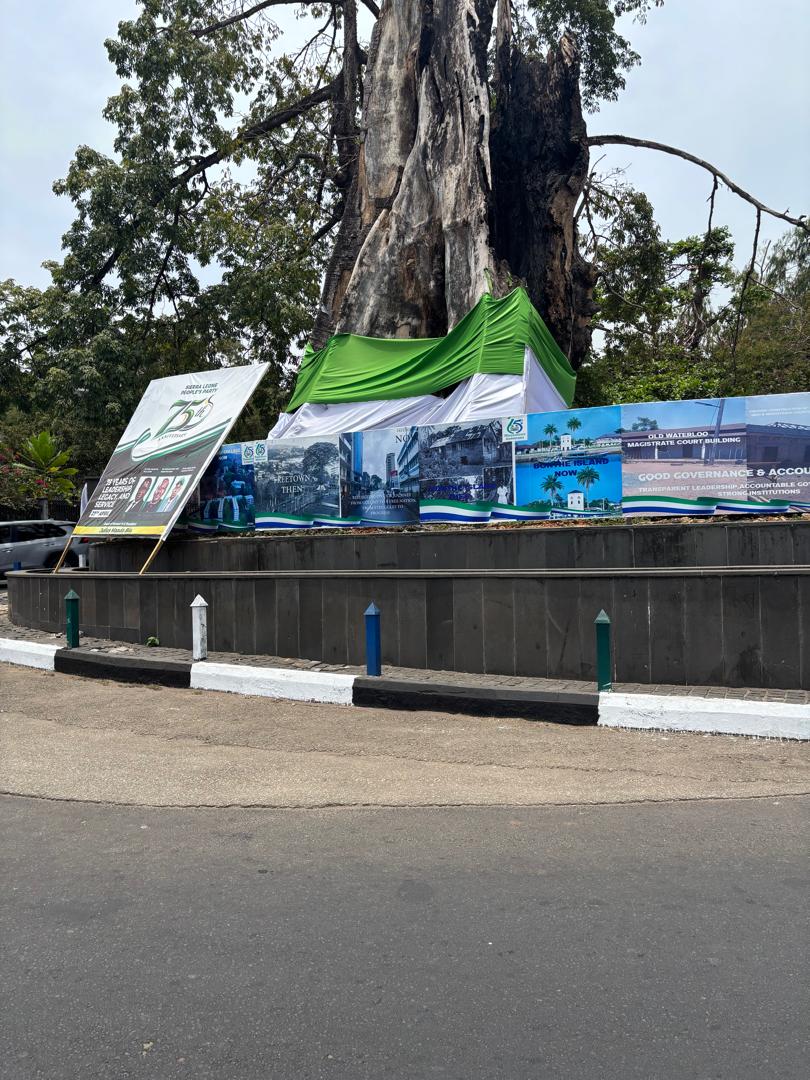
It is the story of a city that has learned to garland decay, to wrap ruin in national colours, to celebrate memory after abandoning responsibility. The remains of the Cotton Tree, decked in the green, white, and blue for Independence Day, now stand as a monument not only to history, but to neglect. It is the perfect civic metaphor: a dead national symbol, ceremonially preserved by a nation that failed to preserve the living thing itself.
Freetown has become a city where decadence is no longer hidden. It is public. It is normalized. It is popularized. It sits in the streets, spills into the gutters, rises from the markets, gathers around cemeteries, and spreads along the waterfront like a second skin.
The city has not simply declined; it has been re-authored by disorder.
At the heart of Freetown’s decay lies a fundamental conundrum: the absence of a governance structure that clearly defines where municipal authority begins and ends, and where the central government — seated in the capital — enters the field of city governance.
Freetown is not merely a municipality. It is also the seat of national power. That double identity has become one of its deepest afflictions. The city is governed by overlap, intrusion, evasion, and ambiguity. No clear line tells the citizen where the council’s responsibility stops and where the central government’s responsibility begins. No settled jurisdictional divide determines who plans, who regulates, who enforces, who funds, who maintains, and who answers when everything fails.
This ambiguity has become fertile ground for conflict. It allows every authority to claim power when there is political advantage, and to deny responsibility when there is civic failure. The municipality blames the centre. The centre overrides the municipality. Agencies multiply. Mandates collide. Instructions descend. Officials hesitate. Traders occupy. Garbage gathers. Roads choke. Cemeteries collapse. Markets drift into the streets.
The result is chaos — par excellence.
Freetown’s crisis, therefore, is not simply the absence of governance. It is the confusion of governance. It is a city where authority is everywhere and nowhere at once; where power intervenes without accountability; where responsibility dissolves into bureaucratic fog; and where the citizen, trapped between municipal weakness and central overreach, is left to suffer the consequences.
A city cannot be governed by blurred lines. It cannot be managed by competing sovereignties. It cannot be rescued by institutions that do not know — or pretend not to know — what belongs to whom.
To make matters worse, Freetown’s post-war urbanisation has outgrown the imagination of those still pretending to plan it.
The war and its aftermath pushed people into the capital and its edges, creating sprawling, populous enclaves on the outskirts of the city. These are no longer rural settlements in any meaningful sense. They are urban extensions, crowded settlements, commuter zones, pressure points, and lived parts of metropolitan Freetown. Yet, through the stubbornness of outdated classification, huge portions of these areas continue to be treated as “Rural Western Area.”
Thus Fourah Bay College, barely minutes from the city centre, is still absorbed into this absurd rural imagination. The new monstrosity called the United States Embassy, located only a short ride from the centre, is also placed within this same fiction of rurality. The classification is not merely inaccurate; it is anachronistic. It belongs to an older Freetown, a smaller Freetown, a Freetown once surrounded by villages rather than swallowed by unchecked urban spread.
At the heart of this misclassification sits the quiet failure of unthinking planners. Their maps may have changed, but their minds have not. Their thinking caps remain wedded to a vanished past: a city ringed by rural villages, rather than a metropolitan organism expanding without order, services, infrastructure, or administrative honesty.
This false rural label is not harmless. It distorts planning. It weakens service delivery. It hides population pressure. It confuses responsibility. It allows government to undercount urban need while pretending that dense, struggling settlements are somehow outside the city’s urgent municipal crisis.
Freetown is not merely expanding. It is expanding beyond the categories used to govern it.
And when a city grows faster than the imagination of its planners, chaos becomes official policy.
Hawkers have taken over the arteries of Freetown, contesting space not only with vehicles and pedestrians, but with the very markets that were built and then abandoned. Streets have become stalls. Pavements have become shops. Junctions have become warehouses. Movement itself has become an act of negotiation. The city no longer directs life; it begs passage through its own congestion.
Downtown Freetown and the east, especially by the Sierra Leone River, now carry the marks of a forced conversion. Public spaces have been seized, traded, tolerated, and normalized until illegality has acquired the confidence of ownership. Squatters and street traders have not merely occupied the city; they have exposed the absence of municipal authority. Where planning retreats, improvisation becomes law.
Amid this rot, subalterns have moved in to govern the spaces vacated by an errant municipality. The city has not become ungoverned; it has become governed differently — by those who seize, occupy, tax, tolerate, trade, and enforce in the absence of legitimate civic order.
From cemeteries to side streets, from mechanics’ corridors to hawkers’ republics, public space has been redistributed by force, necessity, and neglect. Roadside mechanics now occupy whole stretches of the city, converting pavements and shoulders into garages, workshops, scrap yards, and oil-stained waiting rooms. Hawkers commandeer entire streets in the east end, transforming movement into submission and public roads into private bazaars. Night markets rise in public spaces, where pilfered goods are circulated under the watch of the law, as though illegality itself has been licensed by fatigue.
This is the new municipal order: informal, improvised, coercive, and deeply revealing.
The law is present, but not authoritative. Officials are visible, but not governing. Police may watch, but watching is not regulation. City officers may pass through, but passage is not control. The result is a city where the state has not disappeared; it has merely learned to coexist with disorder, to bargain with it, and sometimes to profit from it.
Freetown’s decay therefore cannot be understood only as breakdown. It is also takeover. Every abandoned market, every ruined cemetery, every blocked side street, every illegal stall, every night market of stolen goods is a sign that someone has stepped into the vacuum. The municipality retreats, and another power arrives.
City officials, under pressure or instruction from above, have acquiesced. The municipality has become an office without command, a title without consequence, a structure without civic muscle. Freetown exists, but its municipality has vanished.
Amid this decadence lies another civic failure: the chronic absence of public transportation and social housing.
Every government arrives with fanfare, importing buses as though the mere arrival of vehicles were the same as the creation of a transport system. Ribbons are cut. Speeches are made. Photographs are taken. The buses enter the city as symbols of official concern, only to end their collective lives within a few years — broken, cannibalised, abandoned, or swallowed by the familiar incompetence of maintenance without management.
In the vacuum left behind, tricycles and motorbikes have become the unofficial arteries of Freetown. They do not merely supplement movement; they command it. They have colonised the city’s mobility, turning roads, junctions, alleys, and pavements into contested corridors of improvisation. What should have been a planned transport network has become a survival economy on wheels.
This is not modernization. It is the privatization of desperation.
A city without reliable buses becomes a city of expensive movement for the poor. A city without social housing becomes a city where hillsides, gutters, cemeteries, floodplains, and public spaces are gradually converted into shelter by those the state refuses to house. The same government that cannot move its citizens cannot shelter them either. It watches as the unhoused build where they can, trade where they must, and survive where they are tolerated.
And yet, amid all this rot, the imagination of city leadership drifts upward — literally — toward cable cars and imported fantasies of urban glamour. A mayor looks to Cape Town and speaks of aerial transport, of donor-backed spectacle, of suspended cabins gliding above a city that cannot manage its streets below.
But what is a cable car to a city without drains? What is an aerial tramway to a city without reliable buses? What is donor theatre to a city where markets are abandoned, cemeteries decay, garbage points disappear, and the poor must negotiate movement through tricycles, motorbikes, mud, congestion, and waste?
This is the cruelty of misplaced ambition: the performance of modernity without the discipline of maintenance.
Freetown does not lack dreams. It lacks governance. It does not need another donor promise dressed as transformation. It needs a municipality capable of collecting waste, regulating markets, paying workers, maintaining cemeteries, protecting public spaces, planning housing, and moving people with dignity.
Ask any Freetonian about city governance and they will sneeze before they answer. The sneeze itself is commentary — an involuntary rejection of the dust, decay, and absurdity that now define municipal life. Then they will tell you plainly: the city has no governor. It has offices, titles, convoys, slogans, ceremonies, and development language. But it has no governing hand.
And in that absence, everything descends — except the fantasies, which continue to float above the ruins.
The garbage tells the rest of the story.
The dumpsters and collection points that once suggested some possibility of order have been sold, acquired, commercialized, or simply surrendered. Waste now gathers where policy should have stood. Refuse occupies the city with more certainty than governance. The smell of rot has become part of the urban grammar.
Even the cemeteries are not spared. Public burial grounds, once sites of memory and dignity, now lie in ruins. Workers are reportedly left unsalaried for years, abandoned to the same neglect they are expected to manage. The dead are surrounded by the failures of the living. Some cemeteries have become dumpsites; some are partly occupied by unhoused young men lost to drugs and despair. In such places, the boundary between civic collapse and human collapse disappears.
And so the city is governed by fragments: by hawkers in the streets, by mechanics on the pavements, by drug economies in the cemeteries, by traders in the night markets, by political patrons above them, and by uniformed indifference beside them.
This is the articulation of modern Freetown: a city whose institutions speak in silence, whose jurisdiction is blurred by competing authorities, whose planners mistake metropolitan pressure for rural quiet, whose streets speak in congestion, whose cemeteries speak in abandonment, whose markets speak from the wrong places, whose garbage speaks louder than policy, whose mobility is surrendered to tricycles and motorbikes, whose public spaces are governed by rival authorities, and whose housing crisis is answered by the slow invasion of every available space.
The tragedy is not that Freetown is poor. Poverty alone does not produce this kind of rot. The tragedy is that disorder has been permitted to become culture. Neglect has become administration.
Improvisation has replaced planning. Survival has replaced citizenship. And the state, unable or unwilling to govern the city, now decorates the remains of what it once failed to protect.
Since 2010, the Freetown many knew has steadily ceased to exist. The city of memory — with all its flaws, rhythms, neighbourhood pride, public spaces, civic rituals, and recognisable order — has been overtaken by another city: harsher, more crowded, less governed, less ashamed.
This new Freetown does not decay quietly. It performs decay in daylight.
It is seen in the hawker’s stall on a blocked pavement. It is seen in the abandoned market. It is seen in the cemetery turned dumping ground. It is seen in the unpaid worker. It is seen in the addict sleeping among the graves. It is seen in the roadside mechanic’s oil-stained workshop carved out of public space. It is seen in the night market where stolen goods circulate under official eyesight. It is seen in the garbage point turned private opportunity. It is seen in the tricycle swarm where public transport should have been. It is seen in the hillside shack where social housing should have stood. It is seen in the cable-car fantasy floating above streets that cannot breathe. It is seen in the false rural classification of places already swallowed by the city. It is seen in the stump of the Cotton Tree wrapped for Independence Day.
And perhaps that is the most painful irony: a nation celebrating freedom beside symbols of civic captivity.
Freetown has become a city where rot is not an accident, but an arrangement. Where decadence is not an exception, but a system. Where collapse is not hidden from view, but woven into daily life until people are expected to call it normal.
A city without a municipality is not simply a city without services. It is a city without guardianship. A city without civic memory. A city without shame.
If Freetown was historically linked to Brasil and Nigeria through the Black Atlantic networks forged in the era of the European slave trade, its contemporary affinities are now visible in a different register: in the favelas of Brasil and the sprawling informal settlements of Rio and Lagos, whether on land or on stilts. These informal colonies of subaltern urban life now find their echo on Freetown’s ungovernable hilltops. The proverbial lumpenproletariat of the hills has, indeed, arrived.
Until Freetown’s jurisdictional question is confronted, every promise of renewal will remain cosmetic. The city will continue to be ruled by confusion, contested by informal powers from below, decorated by political theatre, misdescribed by obsolete planners, and abandoned in the name of administrative ambiguity.
And so the Cotton Tree stands — or what is left of it — wrapped in the national flag.
Not as a symbol of renewal.
But as evidence.
Ibrahim Abdullah, 7/6/26